COP31 Zero Waste Museum: an LED tree and an LED globe
The Zero Waste Museum was built in Antalya for COP31, the UN Climate Change Conference. Two custom LED displays in it are by Xeron: an LED tree that is a screen from trunk to branches, and an LED globe that shows the world from every side. Both were designed and built for COP31 alone.
Two shapes taken from nature: a tree and the world.
Neither piece is a product picked from a catalogue. Both were designed for COP31 alone, around the story the Zero Waste Museum tells. Their shapes come from nature: a tree that roots and branches, and the world we all share.
The content speaks the same language. On the tree, leaves grow, flowers open and discarded bottles turn back into a resource, while the trunk reads “Today's waste is tomorrow's resource”. The globe stands among living plants.
Here technology is not set against nature. It is the means of talking about nature and the environment.
The LED tree: the trunk is a screen, and so are the branches.
The LED tree at the centre of the museum is not a set piece with video projected onto it. The tree itself is the screen. The trunk is a cylinder LED screen: a curved LED surface wraps it all the way round. LED ribbons leave the top of the trunk and spread across the ceiling as branches, and short ribbons at the base form the roots.
The whole surface plays as one image. A scene starts on the trunk, climbs into the branches and ends on the ceiling: leaves, glass bottles, stained glass, flowers. In between, the museum's messages are written across the trunk.
The LED globe: the world, our common home.
The second piece is an LED globe: a world whose entire surface is a screen, standing on a round planted platform. This sphere LED display has no corners, no edges and no back. The image reads from anywhere in the hall.
A world map turns on the globe, and the summit's zero waste call is written across it: “Global Commitment to Zero Waste”, “The World, Our Common Home”.
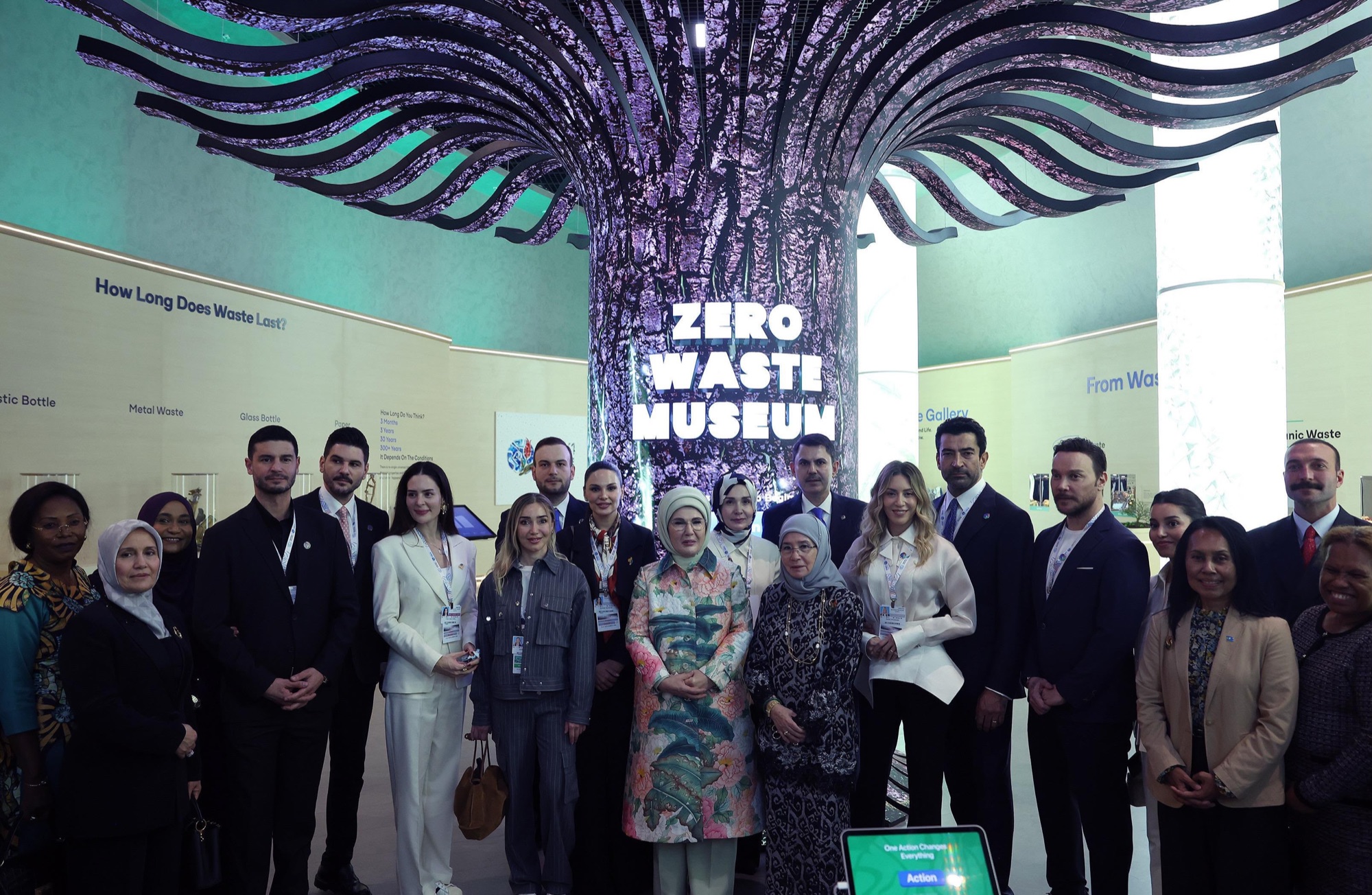
With the contribution of First Lady Emine Erdoğan.
The Zero Waste Museum was realised with the contribution of First Lady Emine Erdoğan and opened to visitors on 12 November 2026 in the Blue Zone of COP31.
The opening was attended by Murat Kurum, Minister of Environment, Urbanisation and Climate Change, along with many well-known names. The commemorative photo of the day was taken in front of the LED tree.
How is a custom-shaped LED screen built?
A flat LED screen is assembled from rectangular cabinets. For shapes such as an LED tree or an LED globe, the cabinet gives way to flexible LED modules and a support structure made for that shape. The shape is modelled in three dimensions first, and the module layout, cable routes and service access are all resolved on that model.
On a cylinder LED screen, flexible LED modules follow the curve of the trunk and form a surface with no visible joints. The branches are built from long, narrow LED ribbons. On a sphere LED display the surface is made of segments shaped to the curvature of the sphere.
The last step is content mapping. The picture is not prepared as a flat video but to the real pixel layout of every surface. That is why a scene does not break as it passes from trunk to branches, and why the map turns on the globe without distortion.
Where are LED trees and LED globes used?
- Museums and exhibitions: a focal point that puts the story in the middle of the room.
- Trade fair and congress stands: a signature piece seen from a distance and from every side.
- Mall and hotel atriums: a centrepiece that fills the void and is watched from the upper floors too.
- Corporate lobbies and experience centres: a permanent installation that carries the brand story.
- Launches and events: a stage element designed for that one day.
LED trees and LED globes: common questions
What is an LED tree?
An LED tree is a custom LED display in the shape of a tree, whose trunk and branches are LED screen surfaces. The trunk is usually a cylinder LED screen and the branches are LED ribbons, and the whole surface plays as one image.
What is an LED globe?
An LED globe is a sphere whose entire surface is an LED screen. With no corners and no back it is watched from every side, and it suits content such as a world map, a planet, a logo or a data visualisation.
Who made the LED tree and LED globe at the COP31 Zero Waste Museum?
Both were designed and built by Xeron for COP31 alone. They were installed in the Zero Waste Museum in the Blue Zone of COP31 in Antalya.
Can an LED tree or LED globe be made for another space?
Yes. These are not off-the-shelf products. They are designed from scratch around the size of the space, the ceiling height, the viewing distance and the story to be told. A tree, a globe, a column, a wave or a ceiling is produced with the same method.
How is content prepared for a custom-shaped LED screen?
Content is prepared to the real pixel layout of the surface. The pixel map and template of the shape are produced first, and the picture is made to that template, so the image is not distorted on the curved surface.
Why use an LED screen in an exhibition about the environment?
One surface can show any number of scenes. When the message changes, no new print, paint or scenery is needed, only new content. On the LED tree at COP31, leaves, flowers and discarded bottles turning back into a resource played on the same surface one after another.
Planning an LED piece made for one space?
A tree, a globe, a column, a ceiling: the space decides the shape of the screen. Tell us about the project and our engineering team will work out how to build it.
START A PROJECT →