LED trees and LED globes: how custom-shaped LED screens are designed and built
What is an LED tree or an LED globe, and how is one made? Cylinder and sphere LED screens, flexible LED modules, content mapping, and the COP31 Zero Waste Museum as the worked example.
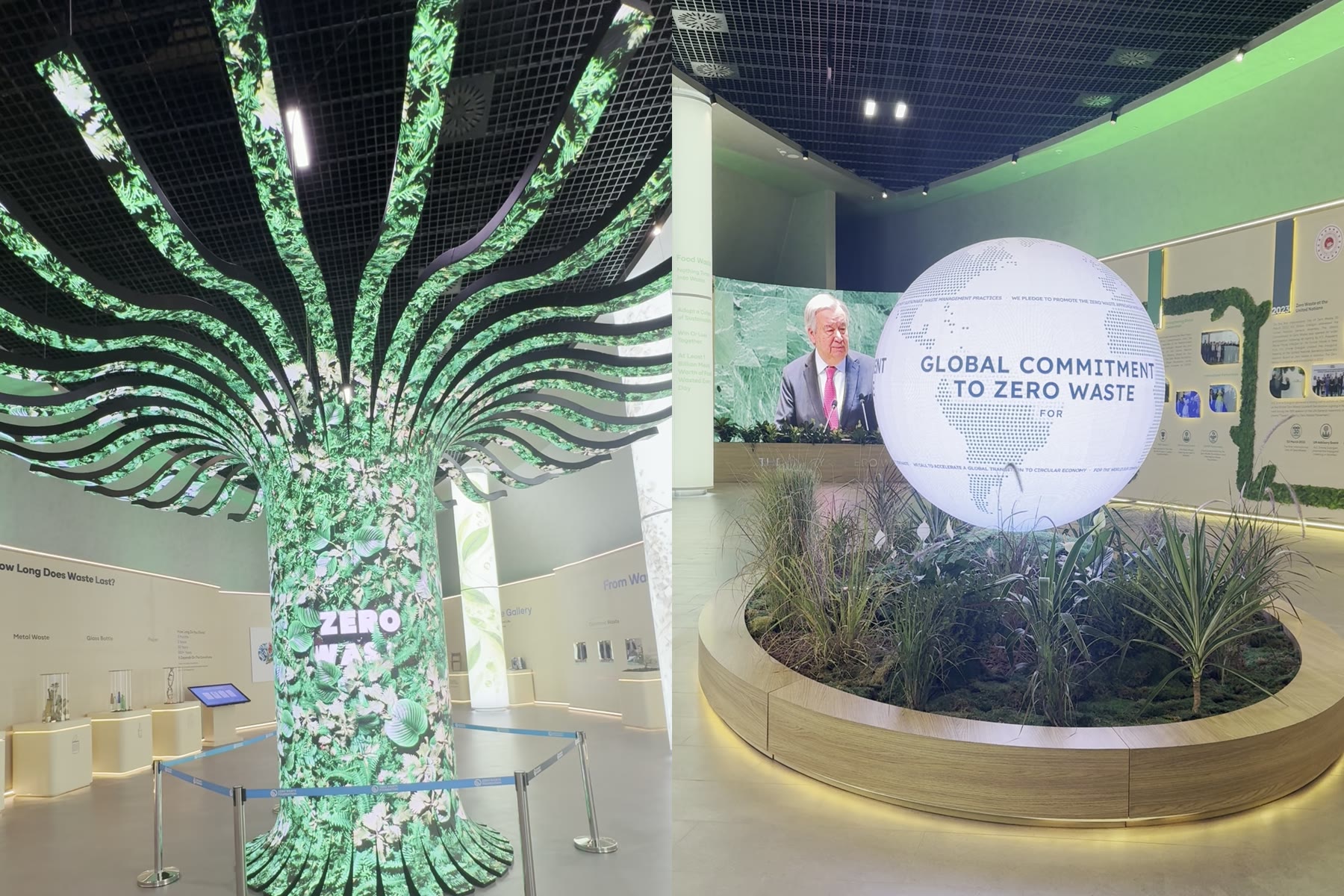
What is an LED tree, and how is an LED globe made? The short answer: both are custom LED screens built onto a shape instead of a flat wall. On the tree, the trunk is a cylinder LED screen and the branches are LED ribbons. On the globe, the whole surface is the screen. This guide starts from the LED tree and LED globe we built for the COP31 Zero Waste Museum in Antalya in November 2026 and explains how custom-shaped LED screens are designed, what they are made of, how the content is prepared and what has to be settled before a project starts.
What is an LED tree?
An LED tree is an LED screen designed in the shape of a tree. It has three parts. The trunk is a cylinder LED screen that shows an image all the way round. The branches are long, narrow LED ribbons that leave the top of the trunk and spread towards the ceiling or into the void. The roots are short ribbons that open towards the floor at the base. All three are connected to the same video processor and play as a single image.
That is what separates it from a decorative light tree. On a decorative tree the LEDs only give light: they change colour but carry no picture. A tree model covered by projection, on the other hand, looks pale in a bright hall, and the shadow of any visitor who steps in front of it falls across the image. On an LED tree every pixel makes its own light. The picture reads in a hall with daylight, visitors can walk right up to it, and there are no shadows.
The storytelling power of an LED tree comes from tying the shape to the content. Leaves can grow upwards from the trunk, water can run from the roots to the branches, and a message can be written around the trunk. On a flat screen all of that is a video you watch. On the tree it happens inside the room.
What is an LED globe and how does it work?
An LED globe is a sphere whose entire surface is an LED screen. A flat screen has a front and a back. A globe has neither: wherever you stand in the hall, part of the image faces you. That is why an LED globe suits places people walk around: the middle of an entrance hall, an atrium void, the centre of an exhibition stand.
A sphere cannot be covered with flat modules. The surface is made of segments arranged in rings of latitude and shaped to the curvature of the sphere: wide near the equator, narrow near the poles. The segments are fixed to an internal support frame, and the power supplies and receiving cards sit inside the sphere or in its base. If the globe stands on a plinth, the bottom pole stays closed. If it hangs, it is carried from the top pole.
The most natural content for a sphere LED display is the Earth. A world map is prepared as one flat image and wrapped onto the sphere, and when it turns slowly it reads as a real globe. The same surface can show planets, weather and ocean data, flight routes, a brand mark or short messages.
The COP31 Zero Waste Museum: a tree and a world
COP31, the UN Climate Change Conference, was held in Antalya in November 2026. The Zero Waste Museum, set up in the Blue Zone of the conference and realised with the contribution of First Lady Emine Erdoğan, opened to visitors on 12 November 2026. The LED tree and the LED globe in the museum were designed and built by Xeron for this event alone. Neither is a product picked from a catalogue. Both were drawn from scratch around the story the museum tells.
The tree stands in the middle of the museum. Its trunk is a cylinder LED screen. LED ribbons leave the top of the trunk and spread across the ceiling as branches, and short ribbons at the base form the roots. The whole surface plays as one image: leaves grow, flowers open, glass bottles pile up on the trunk and rise into the branches, stained glass wraps the trunk. In between, the museum's messages are written across it, among them “Today's waste is tomorrow's resource”.
The globe stands on a round platform surrounded by living plants. A world map turns on it, and the call of the summit is written across the map: “Global Commitment to Zero Waste”, “The World, Our Common Home”. The choice of shapes is not an accident. Both come from nature. The tree speaks of taking root and growing, the globe of the one world we share. The opening was attended by Murat Kurum, Minister of Environment, Urbanisation and Climate Change, along with many well-known names, and the commemorative photo of the day was taken in front of the LED tree.
Here technology is not set against nature. It is the means of talking about it.
What is a custom-shaped LED screen made of?
A flat LED screen is assembled from rectangular cabinets such as 500 × 500 mm. A cabinet is rigid and does not bend, so for shapes like a tree or a globe other parts take its place. The parts list changes from shape to shape, but the skeleton is the same.
- 01Flexible LED module: pixels mounted on a circuit board that bends. The most common sizes are 320 × 160 mm and 240 × 120 mm. It holds onto the structure with magnets and is removed from the front.
- 02Support structure: the steel or aluminium frame that gives the shape. Rings and uprights on a cylinder, meridian ribs on a sphere, bent profiles on the branches.
- 03LED ribbon: a thin, long run of modules made for narrow surfaces such as branches and roots.
- 04Shape-specific parts: boards cut specially for the places a standard module does not fit, such as the poles of a sphere or the joint between trunk and branch.
- 05Power supplies and receiving cards: inside the trunk, in the plinth or above the ceiling, somewhere that can be reached for service.
- 06Video processor and pixel map: the processor that drives every surface as one image, and the map that defines where each pixel is.
The flexible LED module is the building block of this kind of work. On a cylinder LED screen the modules follow the curve of the trunk and form a surface with no visible joints. There is a lower limit to the bending radius: the smaller the diameter, the harder the module is stressed. A slim column and a thick trunk may therefore not be built with the same module, and that decision is taken once the diameter is known.
The design process: seven steps from idea to installation
The hard part of a custom-shaped LED screen is not the installation. It is the drawing that comes before it. To keep surprises off the site, we work in this order.
- 01Idea and story: what will the shape say, where will visitors approach it from, and which message should stay with them?
- 02Site survey: ceiling height, load-bearing points, floor loading, power and data, and the largest part that fits through the door.
- 03Three-dimensional model: the shape is drawn, and the module layout, cable routes and service hatches are resolved on the model.
- 04Pixel pitch: chosen from the closest viewing distance and the content to be shown.
- 05Structural calculation and production: the support structure is calculated, the special parts are made and the piece is pre-assembled in the workshop.
- 06Pixel map and content template: the content team receives a template giving the size and resolution of every surface.
- 07Installation and calibration: the structure is erected, the modules are fitted, colour and brightness are matched across the whole surface and the content is tested on site.
Of these steps, pre-assembly in the workshop saves the most time. The shape is built once before it travels, the content is played on it and the joints are checked. On work tied to an event calendar there is no time to fix mistakes on site. At an event with a fixed opening date such as COP31, everything has to fit the first time.
How to choose pixel pitch and viewing distance
Pixel pitch is the distance between the centres of two neighbouring pixels, measured in millimetres. The working rule is simple: the pitch in millimetres gives the closest comfortable viewing distance in metres. A P2.5 surface looks smooth from 2.5 metres, a P1.8 surface from 1.8 metres. In a museum visitors come very close to the piece, which is why a fine pixel pitch is preferred for work such as a tree or a globe.
On a shaped surface, resolution is worked out along the circumference. A cylinder 1.2 metres in diameter has a circumference of 3.77 metres, so covered at P2.5 it carries about 1,500 pixels around. That number decides how many characters a line of text wrapped around the trunk can hold and how much detail a photograph can carry. A sphere 2 metres in diameter has a surface of about 12.6 square metres, and its equator measures 6.28 metres, which is about 2,500 pixels at P2.5.
The branches are a different case. Branch ribbons sit on the ceiling, far from the viewer, and most of the time they carry colour, movement and texture rather than a detailed picture. A wider pixel pitch than the trunk can therefore be used on the branches. Brightness calls for restraint: indoors, 600 to 1,200 nits is enough. On any piece that will be photographed or filmed, the refresh rate should be at least 3,840 Hz. Below that, black bands appear across the screen in press cameras and phone footage.
Content is prepared for the shape
The most common mistake with a custom-shaped LED screen is to play a video made for a flat screen on it. On a cylinder only part of the image is visible at any one time, so when a 16:9 video is wrapped around a trunk, half of the headline ends up at the back. On a sphere a flat image is squeezed towards the poles.
The right way is to produce the content to a template. The template shows every surface unrolled, with its size in pixels: the trunk opens out as a rectangle, the branches as thin strips, and the sphere as a map twice as wide as it is tall. The designer works on that template, and the processor distributes the picture to the surfaces according to the pixel map.
- 01On a cylinder, keep text short and either repeat it at least twice around the trunk or rotate it slowly, so that it reads from every side.
- 02Move the content in the direction of the shape: from the bottom up on a tree, along the equator on a globe.
- 03Let the image continue across the joint between trunk and branch. If the transition breaks there, the shape turns into two separate screens.
- 04On a globe, keep the important element in the equatorial band. Text near the poles cannot be read.
- 05Divide the loop into short scenes. Visitors do not stand in front of a piece for long.
These principles are easy to see on the tree at COP31. Bottles pile up on the trunk and rise into the branches, leaves spread from the trunk to the ceiling, and the messages are written in large letters on the side of the trunk that faces the visitor. When shape and content are designed together, the screen stops being noticed. Only the tree is left.
Where are LED trees and LED globes used?
These pieces are made to be the signature of a space. They carry a story rather than advertising, so they earn their place where visitors stop and look.
- 01Museums and exhibitions: the symbol of the subject stands in the middle of the room, and the content is updated with the exhibition.
- 02Trade fair and congress stands: a landmark seen from the far end of the hall.
- 03Mall, hotel and airport atriums: watched from every floor of a multi-storey void.
- 04Corporate lobbies and experience centres: a permanent piece that tells what the brand stands for.
- 05Launches, summits and special events: a stage element designed for that one event.
- 06Science centres and planetariums: the Earth, the planets and climate data on an LED globe.
In exhibitions about the environment and sustainability, an LED surface has one more advantage: a single surface shows any number of scenes. When the message changes, no new print, paint or scenery has to be produced. Only the content changes. When the event is over, the modules and the structure are dismantled and can be put up again in another space.
What to settle before the project starts
For a custom-shaped LED screen, the clearer the answers to these questions at the first meeting, the faster the design moves.
- 01Shape and rough size: a tree, a globe, a column, a wave, a ceiling? What height and what diameter?
- 02Space: ceiling height, load capacity, daylight, and the closest point a visitor will stand.
- 03Duration: a permanent installation or a single event? Will it be dismantled and rebuilt elsewhere?
- 04Content: who will produce it, how many scenes, and will there be text?
- 05Date: is the opening day fixed? How much time is there for pre-assembly and rehearsal?
- 06Service: where will the modules be reached from after installation?
Photographs of the space and any architectural drawings help a great deal at this stage. It is enough for the idea to exist as a sketch. The decisions on size, structure and pixel pitch are settled by the engineering work.
Common mistakes
On projects of this kind, trouble usually comes from the order of work rather than from the technology.
- 01Leaving content until last: if the template arrives late, the content is adapted from a flat video and the strength of the shape is lost.
- 02Forgetting service access: if the inside of the trunk or the space above the ceiling cannot be reached, one faulty module holds up the whole piece.
- 03Running the brightness too high: on a piece viewed from close up, excess brightness tires the eye and washes out the colours.
- 04Hanging from the ceiling without a load calculation: branch ribbons are light, but there are many of them, and the fixing points are calculated in advance.
- 05Skipping pre-assembly: problems at the joints should be solved in the workshop, not on site.
If you have a shape in mind, share its size, photographs of the space and what you want it to say. Our engineering team will work out how the shape is built, which pixel pitch suits it and what the content template looks like.
Frequently asked questions
What is an LED tree?
An LED tree is a custom LED screen in the shape of a tree. Its trunk is a cylinder LED screen, its branches are LED ribbons and its roots are short ribbons at the base. All the surfaces are driven by one processor and play as a single image, so a scene can start on the trunk and continue into the branches.
What sizes can an LED globe be made in?
An LED globe can be made from table-top size to several metres in diameter. Resolution rises with diameter, so a larger globe shows finer detail. The right diameter depends on the height of the space, the viewing distance and whether the globe will stand on a plinth or hang.
Which pixel pitch suits an LED tree?
Indoors, where visitors come within a metre or two of the trunk, P1.8 to P2.5 gives a good result. The branches are further away and usually carry colour and movement rather than detail, so a wider pitch can be used there. The decision is taken from the closest viewing distance and the content.
Can an LED tree or LED globe be used outdoors?
Yes, but it is designed separately for outdoor use: modules protected against dust and water (IP65), brightness high enough to read in sunlight and a structure calculated for wind load. A piece made for indoor use is not moved outside.
Who prepares the content for a custom-shaped LED screen?
The client's agency, the exhibition designer or a content team we recommend can prepare it. What matters is that the team works to the pixel map and template of the shape. The template is delivered during the design stage, so content production runs alongside manufacturing.
What happens to an LED tree or LED globe after the event?
The modules and the support structure are dismantled. If the design allowed for it, the piece can be rebuilt in another space or moved into a permanent exhibition. That is why a structure that can be taken apart and reassembled is preferred even for single-event work.
Who made the LED tree and LED globe at the COP31 Zero Waste Museum?
Both were designed and built by Xeron for COP31 alone. They were installed in the Zero Waste Museum in the Blue Zone of COP31 in Antalya, which opened to visitors on 12 November 2026.