Stadium and arena LED screens: scoreboards, perimeter boards and ribbon displays explained
Stadium LED screen guide: scoreboards, perimeter boards, ribbon displays and center-hung cubes, with pixel pitch, broadcast, brightness and structure explained.
A stadium LED screen is not one product but a system of four: the main scoreboard or video board, the perimeter boards along the pitch, the ribbon displays on the tribune edge and, in indoor arenas, the center-hung cube above the court. One of them is judged by a television camera rather than by the crowd. This guide shows how to specify each type, from pixel pitch and broadcast performance to brightness, structure and control, and closes with two worked examples.
The four stadium LED screen types in one venue
Main scoreboard and video board
The main board carries the score, the clock, line-ups, live video and replays. In an open stadium it is usually a pair of screens at opposite ends, on the roof structure or a steel tower, so that every seat sees at least one. At 40 to 120 m² per board it is the largest surface in the venue. A traditional LED scoreboard showed digits only; today the score is one graphic layer on a full video surface.
Perimeter LED boards along the pitch
Perimeter LED boards replace the printed hoardings around the field of play. They are low, about 0.9 to 1 m high, and long: on a football pitch the run along the far touchline and behind both goals comes to 240 to 260 m. Their real audience is at home, because they sit opposite the main broadcast camera and appear in every wide shot. They are therefore specified around the camera and player safety, not around the stand.
Ribbon and fascia boards on the tribune edge
A ribbon board, or fascia display, is a long, narrow LED band on the front edge of an upper tier or balcony, 0.6 to 1.2 m high and tens or hundreds of metres long. It carries sponsor loops, statistics and safety messages. Ribbons are read from across the bowl, so the pitch can be coarse; following the curve of the tier makes cabinet geometry and cabling the real design questions.
Center-hung cube for indoor arenas
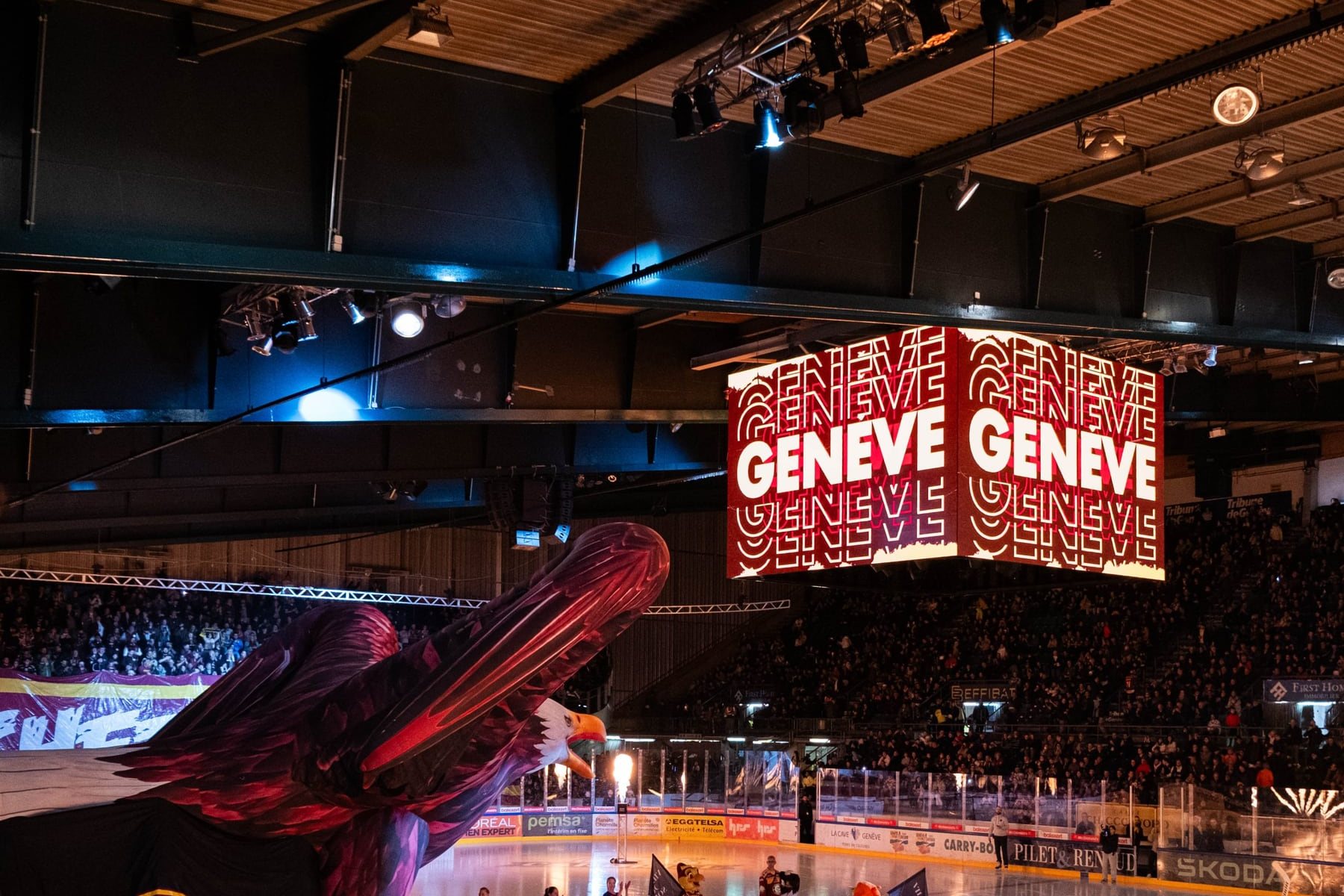
An indoor hall has no far end for a screen, so the video board hangs over the centre of the court: four faces suspended from the roof trusses on hoists. This arena center-hung display is the closest large screen to its audience in sport, with the front row 15 m away and the top row about 40 m. It is also a load suspended above the players, which puts weight and rigging first in the specification.
Stadium LED screen pixel pitch: start from the real viewing distance
The rule from our pixel-pitch guide holds in sport too: the pitch in millimetres is roughly the minimum comfortable viewing distance in metres, and the image looks best from two to three times that. The nearest viewer of a main board may be 50 m away, so the limit is not visible pixels but the pixel count available for video and the character height read from the furthest seat. As a starting point:
- 01Main scoreboard or video board, open stadium, 50–150 m: P6 to P10.
- 02Center-hung cube, indoor arena, 15–40 m: P3.9 to P5.9.
- 03End-wall scoreboard, indoor arena, 25–60 m: P4.8 to P6.9.
- 04Perimeter LED boards: P6 to P10, confirmed by a camera test.
- 05Ribbon board read across the bowl: P10 to P16 outdoors, P6 to P10 indoors.
Scoreboard seen from 50 to 150 m: P6 to P10
By the distance rule alone a 16 mm screen would do, but a video board has to show a replay worth watching. A board of 12.5 × 6.7 m has about 1,560 × 840 pixels at P8 and 1,250 × 670 at P10; at P16 the surface drops to 780 × 420 and faces turn into blocks. For text, plan a character height of at least 1/300 of the longest viewing distance: 0.5 m at 150 m.
Indoor arena cube seen from 15 to 40 m: P3.9 to P5.9
A cube is read from 15 to 40 m and its faces are small, often 10 to 25 m² each; both facts push the pitch down. At P3.9 a 4.5 × 2.5 m face has 1,152 × 640 pixels, enough for replay and statistics side by side. At P5.9 it has about 760 × 420, which suits a hall where the cube mostly shows score and clock. Anything finer than P3.9 only adds weight and power to a suspended structure.
Perimeter boards are judged by the TV camera, not the crowd
The nearest spectators are 10 to 20 m away and watching the match, not the board. The camera is 60 to 90 m away, but it zooms: in a tight shot the board can fill a third of the frame. Pitches of 6 to 10 mm are common, and the decision is made by filming a sample from the real camera positions. A finer pitch helps mainly by moving moiré out of the usual focal lengths.
Broadcast requirements: what the camera sees
Refresh rate and scan ratio
A screen that looks perfect to the eye can be unusable on television: the eye integrates light over time, while a broadcast camera samples it in slices as short as one thousandth of a second. Refresh rate, how often the drivers redraw the LEDs, is therefore the first figure to check. At 1,920 Hz a fast shutter catches the screen between refreshes and black bands roll through the sponsor's logo. The floor for a televised surface is 3,840 Hz, and 7,680 Hz is worth asking for near super-slow-motion positions. Ask also for the scan ratio: a static or low-multiplex drive keeps each LED lit for more of the frame.
Grey scale at low brightness, colour and moiré
Evening matches are played under floodlights with the boards dimmed to 20 to 30 percent of daytime output. Poor driver chips lose grey levels as they dim: gradients break into bands and skin tones in a replay turn blotchy. Colour should be calibrated to the broadcast colour space with an adjustable white point. Moiré, the interference between the LED grid and the camera sensor, is reduced by a finer pitch, a well-designed mask and a camera test before ordering. Put these points in the specification:
- 01Refresh rate of 3,840 Hz or higher, measured at match brightness, not at full output.
- 02Scan ratio stated on the datasheet, with low-multiplex drive on camera-facing surfaces.
- 03Grey scale of 14 to 16 bits, demonstrated at 20 percent brightness.
- 04Frame rate locked to the broadcast standard, 50 Hz in Turkey and Europe, with a genlock input.
- 05Latency of two to three frames at most between camera and board.
- 06A filmed test from the real camera positions, including a tight zoom, before acceptance.
Perimeter LED boards: player safety, tilt and virtual advertising
Soft mask, padding and impact resistance
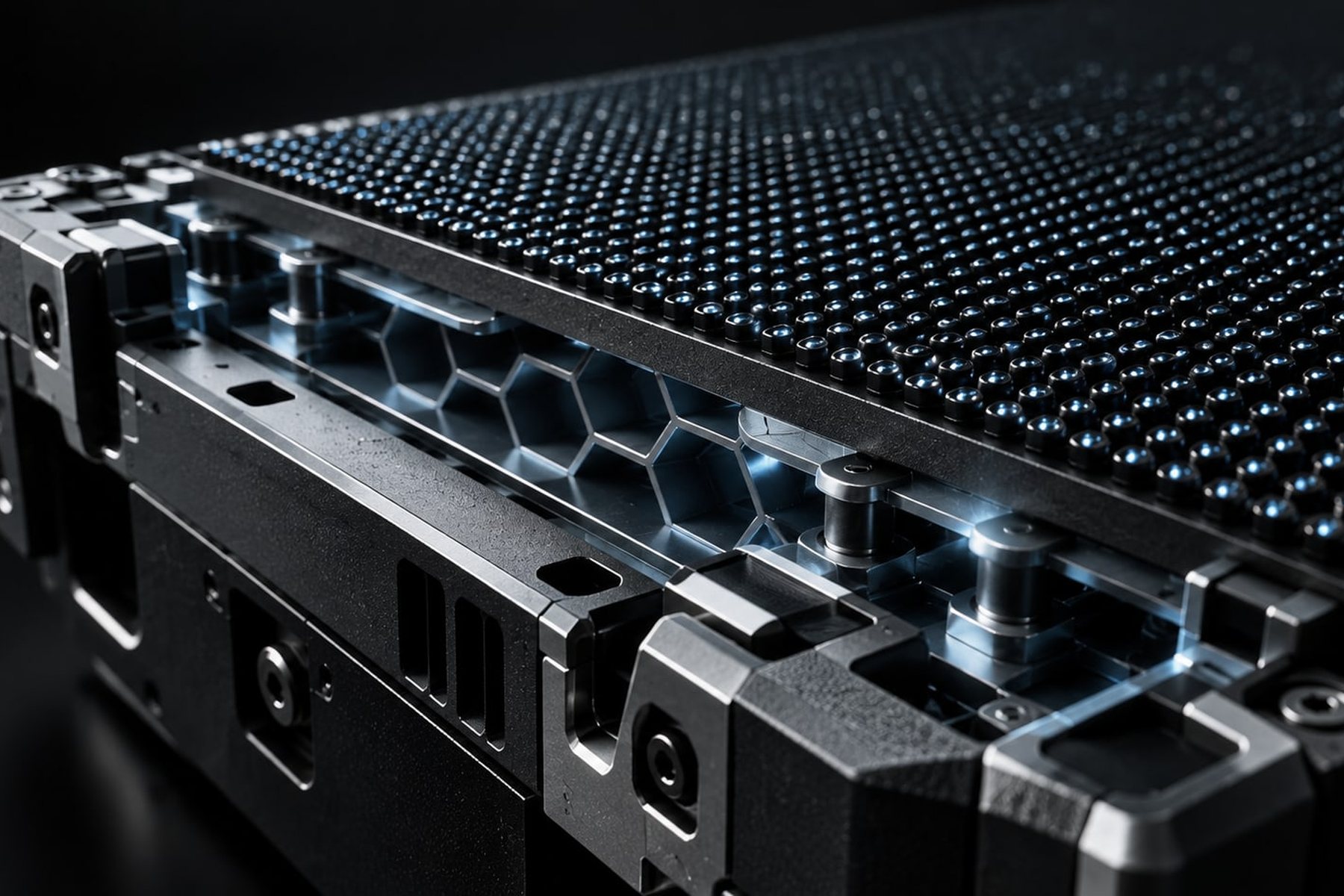
A perimeter board is the only LED screen an athlete is expected to hit at full speed; it also takes ball strikes above 100 km/h. Its face therefore uses a soft mask, a flexible rubber or polymer front on each module instead of a rigid louvre, which yields under impact and does not cut skin. The top edge carries a continuous padded cushion, corners are rounded and nothing protrudes on the pitch side. Ask for the impact test report.
Tilt angle, height and line of sight
Perimeter cabinets stand on adjustable rear legs that tilt the face back, typically by 0 to 15 degrees. The tilt points the brightest part of the LED beam towards the main camera platform. Height is limited by the sight lines of the front rows: 0.9 to 1 m is usual. The run must leave gaps for emergency access, stretcher routes and the players' tunnel, each closed with a quick-release gate.
Virtual advertising overlays and federation rules
Rights holders increasingly sell the same position several times, replacing the board content in each regional feed with a virtual overlay. Depending on the method, the boards need a flicker-free image locked to the camera, uniform colour along the run or a special high-frame-rate mode, so ask which method the competition uses. Federations and organisers also regulate perimeter systems in general terms: distance from the touchlines, height, brightness and animation during play, and padding. Obtain the current regulations for your sport and level and make compliance a written condition of supply.
Brightness and sun orientation for a stadium LED screen
An open stadium needs 6,000 to 8,000 nits on its main boards; an indoor arena needs 1,500 to 2,500. Football pitches usually run north to south, so in the northern hemisphere the south-end board faces north, sits in shade all day and is comfortable at 6,000 nits, while the north-end board faces south into direct sun and needs 8,000 nits and a deeply shaded mask. West-facing boards meet low sun in late-afternoon matches. At night, under floodlights, a board left at full output glares at the crowd and blows out on camera, so an ambient light sensor should bring it down to 1,500 to 2,500 nits.
IP65, wind load, steel and the structural report
Everything in our outdoor LED buying guide applies here. Main boards and outdoor ribbons must be IP65 front and rear, because a board on a roof edge has its back in the weather. Perimeter boards need the same rating plus sealed connectors at ground level, where they stand in irrigation spray. XR Arena cabinets are sealed on both faces; for permanent boards on towers, XR Vision and XR Rugged are the fixed-installation alternatives.
A video board is a sail. An 84 m² board mounted 25 to 30 m above ground sees a design wind pressure of 1.2 to 1.5 kN per square metre, or 100 to 125 kN of horizontal force on the steel, plus the cabinet weight and, in Turkey, the seismic case. If the board hangs from the roof, the roof's engineer must confirm the load. A structural report signed by a licensed civil engineer is a condition of installation. Where the roof cannot carry a solid board, mesh such as XR Air cuts weight and wind area.
Control room, live video, replay and scoring system integration
The screens are the visible half of the system. The other half is a control room with a view of the field, where an operator mixes live camera feeds, instant replay, scoring data and prepared content. The processor must scale broadcast signals to unusual resolutions: a 200 × 1 m ribbon is some 20,000 pixels wide at P10, which no standard video format covers. The graphics should read the official timing and scoring consoles directly, and regulatory displays such as shot clocks should stay on even if the video system fails.
Redundancy: dual power and dual signal
A black screen in front of a full stadium and a live broadcast is the failure the design must exclude. Each cabinet receives data from two directions, in a loop fed by a primary and a backup controller, so a broken cable causes no visible gap. Power is split across at least two independent feeds, so a tripped breaker darkens alternate cabinets, not the whole board. Controllers sit on a UPS and the fibre follows two routes.
Sponsorship and fan engagement: what the screens are for
The first argument for LED in a sports venue is inventory: a static hoarding carries one sponsor for a season, while a perimeter LED board carries many in rotation and can give one partner the whole ring for a goal celebration. What that is worth is a commercial calculation for the club, not something a screen supplier can promise. The second is the experience in the seats: replays, statistics, line-ups, full-bowl animations and safety messages all run on the same surfaces.
A stadium LED screen has two audiences: the crowd, which forgives a great deal, and the broadcast camera, which forgives nothing. Specify for the camera and the crowd is looked after too.
Maintenance: catwalks, service access and spare modules
A module will fail during the season, and the question is how quickly a technician can reach it. Large video boards are rear-serviced from catwalks built into the steel: a walkway at every second or third cabinet row, 600 to 800 mm clear width, guard rails and fall-protection anchors, all in the structural design from the first drawing. Center-hung cubes are lowered to the floor, so the hoists need scheduled inspection and load testing. A faulty perimeter cabinet is swapped in minutes if spares are on site. Keep 3 to 5 percent spare modules from the same production batch.
Worked example: an open 20,000-seat stadium
Take an open football stadium with 20,000 seats and a north-south pitch. The furthest seat is about 160 m from either end on the diagonal. Two main boards of 12.48 × 6.72 m stand at opposite ends, each built from 13 × 7 cabinets of 960 × 960 mm: 84 m² and 1,560 × 840 pixels at P8. The north-end board, facing south, is specified at 8,000 nits and the south-end board at 6,500. Each peaks at about 60 kW, averages near 20 kW and weighs some 3.5 tonnes in cabinets alone.
The perimeter system runs along the far touchline and behind both goals: about 250 m of boards 0.96 m high, 240 m² in total, at P8 with soft masks, a padded top edge, 3,840 Hz refresh, tilt adjustable to 15 degrees and four quick-release gates. A ribbon 1 m high on the upper-tier fascia of the two long stands adds 2 × 110 m at P10. Everything runs from one control room with backup controllers, looped data and split power feeds.
Worked example: a 5,000-seat indoor arena
Now take a 5,000-seat indoor arena for basketball and volleyball, with viewing distances of 15 to 38 m. A center-hung cube with four faces of 4.5 × 2.5 m, built from 500 × 500 mm cabinets, gives 45 m² and 1,152 × 640 pixels per face at P3.9, with a 0.5 m ring beneath for score and clock. Brightness is 2,000 nits, run at about half under the sports lighting. With frame and hoists the suspended load reaches 3 to 4 tonnes, which the roof engineer must approve as point loads on the trusses.
Each sport sets a minimum free height above the court, volleyball being the most demanding, so the lower edge of the cube sits above the highest requirement and the hoists can raise it for concerts or lower it for service. Peak power for cube and ring is about 27 kW, the average near 9 kW. Two end-wall scoreboards of 6 × 3.5 m at P4.8 back up the cube, and 60 m of soft-mask perimeter boards line the camera-facing side.
If you are planning a stadium LED screen, a perimeter system or a center-hung cube, send Xeron the venue drawings, the viewing distances and the competition requirements. Xeron quotes each project after a site survey, because pixel count, steel and broadcast-grade electronics weigh differently at every venue. We will return a specification built on XR Arena and on the fixed-installation series where they fit. Use Start a Project on xeron.co to begin.
Frequently asked questions
Which pixel pitch is right for a stadium LED screen?
For a main scoreboard or video board read from 50 to 150 m, choose P6 to P10; P8 is a common answer for a board of around 80 m². An indoor center-hung cube read from 15 to 40 m needs P3.9 to P5.9. Perimeter boards run at P6 to P10, confirmed by a camera test.
How bright should a stadium LED screen be?
An open stadium needs 6,000 to 8,000 nits, with the higher figure for boards facing south or west into direct sun. An indoor arena needs 1,500 to 2,500 nits. In both cases an ambient light sensor should dim the screens under floodlights, so they neither glare at the crowd nor blow out on camera.
Why do perimeter LED boards need a 3,840 Hz refresh rate?
Because broadcast cameras use fast shutters that catch a slow-refreshing screen between redraws, which shows on television as black bands or flicker across the sponsor's logo. A refresh rate of 3,840 Hz or more, a low scan ratio and good grey scale at reduced brightness keep the image clean on camera.
What makes a perimeter LED board safe for players?
A soft mask on every module, a continuous padded top edge, rounded corners and no protruding parts on the pitch side. The cabinet stands on tilting rear legs that give slightly on impact, and the modules are tested against repeated ball strikes. The run also needs quick-release gates on emergency routes.
What is a center-hung LED cube and how heavy is it?
A center-hung cube is a four-sided LED display suspended above the centre of an indoor court, often with a ring beneath for score and clock. For a 5,000-seat arena, a cube of about 45 m² weighs 3 to 4 tonnes including frame and hoists, and the roof engineer must approve the point loads.
How is a stadium LED screen protected against failure during a match?
Through redundancy at every level. Data reaches each cabinet from two directions, fed by a primary and a backup controller that takes over automatically. Power is split across independent feeds so that a tripped breaker never darkens the whole board. Controllers run on a UPS, and spare modules from the same batch are kept on site.