LED screen rental guide 2026: how to size a wall, choose a pixel pitch and compare quotes
LED screen rental in Istanbul: what drives the cost of a hire, how to size a wall, indoor vs outdoor, pixel pitch, crew and 12 questions to ask before you book.
LED screen rental is usually the last line an event budget gets right and the one that swings the most between quotes. This guide covers three things: what actually drives the cost of a hire, how to size a wall and choose a pixel pitch from where your audience actually sits, and the 12 questions that make two LED wall hire quotes comparable. There is no rate card here, because a rental is always priced against the job in front of it; the worked examples run from a hotel ballroom to an open-air stage.
When LED screen rental makes sense, and when buying does
The simplest test is days of use per year. A brand, agency or event company that puts a screen in front of an audience for fewer than about 30 days a year is almost always better off renting. Inventory, storage, calibration, spares and the crew who know the system stay on the rental company's side of the ledger. A venue, studio, house of worship or corporate lobby that runs a display every day buys, because continuous hire stops making sense against a wall the organisation would own outright.
There is a middle ground. An event company running eight to ten shows a year can pay off 20–30 m² of rental-grade inventory in roughly two years, but that is a business decision that includes a processor, rigging hardware, a truck and trained staff, not just a screen purchase. This guide stays on the rental side; what drives the cost of buying outright is covered separately in our LED screen cost guide.
The six items behind a rental LED screen quote
A rental LED screen quote looks like one number. Behind it sit six separate items, and most of the difference between two quotes for the same wall comes from how those items are packaged rather than from the cabinets themselves.
Square metres and pixel pitch
The base unit of the calculation is the square metre per day. For the same area, the cost rises as the pitch gets finer: a 1.9 mm cabinet carries almost twice the LEDs of a 2.6 mm cabinet and four times those of a 3.9 mm one, and the driver electronics scale with it. Choosing a pitch before you know the closest viewing position is the most expensive mistake in LED wall hire. A stage watched from 8 m does not need 1.9 mm; an exhibition stand read from 1 m shows visible pixels at 3.9 mm.
Days and indoor versus outdoor
The headline figure in a quote covers the first show day. Set-up and strike days, and the second and later days of a multi-day event, are normally charged at a reduced rate rather than as full days, so a four-day fair is nothing like four times a one-day job. Outdoor cabinets sit above indoor ones at the same pitch because they carry IP65 sealing, 4,000–5,500 nits of brightness and need ground support engineered for the site wind load.
Crew, operator and logistics
The cabinet line does not build the wall. A two- to four-person install crew, an operator who stays with the screen through the show, the truck, rigging or truss, power distribution and spare cabinets are separate lines. On small jobs those lines outweigh the screen itself, which is why a 6 m² stand screen is quoted as one complete package rather than by area alone.
What sets the cost of an LED screen rental, and how to compare two quotes
There is no single rate for LED screen rental, and a supplier who gives one over the phone is guessing at half the job. What a hire costs is set by a short list of variables, and every one of them is something you can settle before you ask for a quote. Write them down once and send the same brief to everybody: only then are two suppliers pricing the same job, and only then does comparing them mean anything.
- 01Area and pixel pitch: the square metres of wall and the millimetres between LEDs. A 1.9 mm cabinet carries about four times the LEDs of a 3.9 mm one, and the driver electronics scale with it.
- 02Indoor or outdoor: IP65 sealing, 4,000–5,500 nits and weather-rated connectors sit above an indoor cabinet of the same pitch.
- 03Days on site: the show day, plus set-up, rehearsal and strike days, plus any dark days the wall stands idle between sessions.
- 04Rigging method: hanging from truss or ceiling points needs point-load figures and certificates; ground support needs ballast and a wind-load calculation. The two are not interchangeable.
- 05Crew and operator: how many technicians build the wall, how many hours the operator stays, and whether the work runs overnight or inside a narrow venue build-up window.
- 06Transport and access: distance, truck size, a loading dock or a stair carry, parking permits and the venue's own handling rules.
- 07Signal and content: processor, media server, a redundant feed, and whether someone has to rebuild content to the wall's pixel canvas.
- 08Spares and insurance: about 5% of the wall in spare cabinets, modules and power supplies, plus cover for the equipment while it is on site.
Comparing two quotes is a subtraction exercise. Put them side by side and line up the same seven rows: area and pitch, days, rigging, power, signal, people, and spares with transport. A quote that comes in lower and stays silent on three of those rows is not cheaper, it is smaller. The gaps we see most often are an operator who leaves once the doors open, rigging that is quietly assumed to be the venue's problem, and a set-up day that reappears afterwards as an extra line.
The other half of the comparison is what each supplier actually brings to site. Cabinets of the same nominal pitch differ in age, brightness uniformity and refresh rate, and a wall last calibrated two seasons ago shows it on camera. Ask for the pitch in millimetres, the brightness in nits, the refresh rate in Hz and the cabinet count in writing, and ask when those cabinets were last serviced. Once your size, pitch, dates and venue are on the table, we prepare a written quote for that job rather than reading from a list.
Sizing by event type: four Istanbul scenarios
Size starts with the audience, not the room: the distance to the nearest and the farthest guest, the ceiling height and the stage width. Rental cabinets are 500 × 500 mm or 500 × 1000 mm, so wall dimensions are planned in half-metre steps. The four scenarios below are the jobs we see most often in Istanbul.
A 400-person launch: a 6 × 3.5 m wall
For a product launch for 400 guests in a hotel ballroom or a congress centre, a 6 × 3.5 m main screen, 21 m², is the standard answer. At 2.6 mm the wall resolves about 2,300 × 1,350 pixels, so Full HD content plays without upscaling and a custom canvas can use the extra width. In 500 × 500 mm cabinets that is 12 × 7 = 84 cabinets; a two-person crew hangs, cables and line-checks it in four to five hours. Plan two days on site: a set-up day for rigging, cabling and the content load, then the show day with an operator at the desk.
A hotel ballroom wedding: 4 × 2.5 m
For 200–300 guests a 4 × 2.5 m backdrop, 10 m², is enough. Even 3.9 mm reads cleanly from 5 m, but photographers and video crews will ask for 2.6 mm. Ballroom lighting is low, so 800–1,000 nits is plenty and the cabinets run at 30–40% brightness. A wall this size is normally quoted as one package with the install crew inside it and the operator on a separate line, so check which of the two your quote covers before you compare it with anything.
An open-air concert: a 10 × 6 m main screen plus side screens
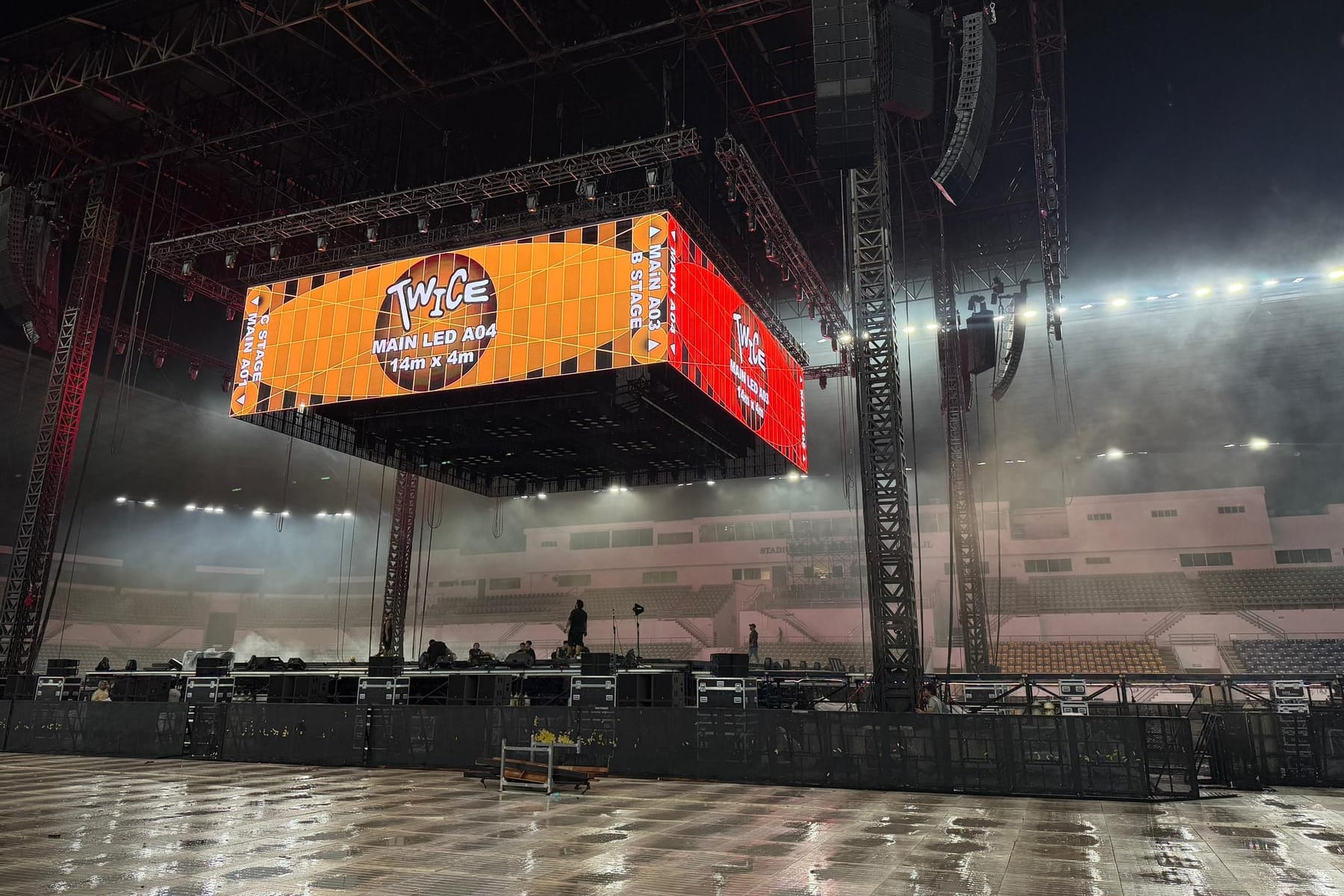
A typical open-air stage carries a 10 × 6 m main screen, 60 m², and two 4 × 3 m side screens, 84 m² in total. Pitch is 3.9–4.8 mm, brightness 5,000 nits, the cabinets are IP65 and the ground support is engineered for the site wind load. At this scale the screen is only part of the job: truss, ground support, a generator, power distribution and a six-person crew are all separate lines, and the site itself, its access, its ground and its wind exposure, decides how much structure the wall needs. The install takes a full day.
An exhibition stand: 3 × 2 m for four days
For a stand back wall at CNR Expo or Tüyap a 3 × 2 m screen, 6 m², is planned at 1.9–2.6 mm because visitors read it from a metre away. The fair runs four days, so the days after the first are charged at a reduced rate and the whole run is normally quoted as a single package. The venue's power application and its build-up time window belong in the quote, and overnight installation can carry a surcharge.
A shopping-mall activation
Mall atriums under glass roofs carry daytime ambient light above 2,000 lux, so a 3 × 2 m indoor screen there needs at least 1,500 nits rather than the 800 a ballroom would take. Mall management sets rules on power, noise and installation hours; passing those to the supplier before the quote saves the day itself.
What you pay for in LED screen rental is not square metres. It is a wall that plays from the first frame to the last.
What a good LED wall hire quote contains
A quote that reads "LED screen rental" on one line with a single figure at the end cannot be compared with anything, and it cannot be checked on site either. A comparable quote lists the items below separately. Every line that is missing comes back on show day as an extra invoice or as equipment that is not there.
- 01Screen: width × height, total m², pixel pitch, cabinet size and count, total resolution, brightness in nits and refresh rate.
- 02Days: show day, set-up and strike days, rehearsal time, each with its own price.
- 03Rigging: truss, ground support or ceiling points; who supplies it, the point-load calculation and certificates.
- 04Power: total kW, distribution board, and whether a generator is needed and who provides it.
- 05Signal: processor inputs (HDMI, SDI), a redundant feed, and the media server or player.
- 06People: crew size for the install, operator hours on site, and how overnight work is charged.
- 07Spares, transport, insurance and VAT; cancellation and weather clauses.
How the install day runs
The sequence of a rental LED screen install is the same on every job. The rigging goes up first; the cabinets hang from header bars and lock to their neighbours with quarter-turn latches; each column is chained on a redundant data loop; the processor maps the wall; a test pattern walks every cabinet and the wall is white-balanced against the lighting rig. A two-person crew hangs 20–30 m² of lightweight rental cabinets an hour, so the 21 m² launch wall is ready, line-checked, in an afternoon.
Rehearsal time is the most important line in the quote. The wall should be balanced and loaded with content at least two hours before the presenter and the content team arrive, and brightness gets its final trim once the room lighting is set. The full install order and the pre-show checklist are covered step by step in our rental stage build guide.
12 questions to ask before you book LED screen rental
These questions are not a test for the supplier. There is no market rate to hold a quote against, so the only way to judge one is by how much of the job it spells out. Ask them in writing and keep the answers with the quote: that wording becomes the scope you agreed on, and every question that does not get a clear answer is a risk item on show day.
- 01What is the exact pixel pitch in millimetres and the brightness in nits? Both belong in the quote as numbers; "high resolution" is not a specification.
- 02What are the cabinet size and count, and what is the total resolution of the wall in pixels? The content team works from that figure.
- 03Does the quote include installation, strike and transport, and are set-up and strike days written as their own lines?
- 04Does an operator stay on site through the event, for how many hours, and how is overnight work charged?
- 05Are spare cabinets, modules, power supplies and receiving cards included? The industry standard is about 5% of the wall.
- 06For outdoor dates, what is the IP rating, is there a wind-load and ballast calculation, and at what wind speed is the show stopped?
- 07Who supplies the rigging, truss, ground support or ceiling points, and are point-load calculations and certificates available?
- 08What is the total power requirement in kW, who brings the distribution board, and is a generator needed?
- 09Which inputs does the processor accept (HDMI, SDI), is there a redundant signal path, and what is the refresh rate for camera-facing work?
- 010In what resolution and format should content be delivered, who handles the scaling, and what is the delivery deadline?
- 011When does the install start, at what time is the wall ready for rehearsal, and is the venue's build-up window reflected in the quote?
- 012What are the damage, insurance, cancellation and weather clauses, and are the payment schedule and VAT stated clearly?
Which Xeron rental series fits which job
The Xeron XR Event series, in 500 × 500 mm and 500 × 1000 mm cabinets, carries the bulk of indoor and outdoor event work; most launches, weddings and congress jobs are built on it. XR Arena is the large-stage and open-air concert option, with higher brightness and a ground-support system designed for wind load. XR Flex builds curved backdrops with ±15° locking steps between cabinets. XR Bastion is the rugged choice for outdoor dates in harsh weather, and XR Essential is the entry option for small indoor jobs with straightforward requirements.
If the date, the venue and the guest count are known, a sizing proposal takes a day. Leave a short brief on the Start a Project page and we will return a written quote for your job, with pixel pitch, cabinet count, crew and the install plan set out line by line so you can hold it against anything else on your desk.
Frequently asked questions
How much does LED screen rental cost per day?
There is no single day rate. A hire is priced on the area in square metres, the pixel pitch, indoor or outdoor cabinets, the days on site including set-up and strike, the rigging method, crew and operator hours, transport and spares. Xeron prepares a written quote for each job once the size, pitch, dates and venue are known.
What is the smallest LED screen you can rent?
Rental cabinets are 500 × 500 mm, so the practical minimum is a 2 × 1 m screen, 2 m²; for exhibition stands and stage edges 3 × 2 m is the most common small size. A wall this small is quoted as a complete package with install and an operator rather than by area, because the crew, the truck and the processor are the same either way.
Does an outdoor rental LED screen work in the rain?
Yes. Outdoor rental cabinets are IP65 sealed and run in rain, provided the power and data connections use glands and the cables are laid with drip loops. The real risk is wind rather than water: a ground-supported screen needs a ballast and wind-load calculation, and the quote should state the wind speed at which the show is stopped. Indoor cabinets are never used outdoors, even under a tent.
How long does a rental LED wall take to set up?
A two-person crew hangs 20–30 m² of rental cabinets per hour. A 10 m² wedding backdrop is ready in two to three hours including rigging, a 21 m² launch wall in four to five hours, and a 60 m² open-air concert screen with truss and ground support in a full day. Add at least an hour on top for processor mapping, the test pattern and white balance.
Who prepares the content for a rented LED screen?
The client or their agency produces content; the rental company supplies the wall's pixel resolution, aspect ratio and accepted formats in writing a week before the install. For a 6 × 3.5 m wall at 2.6 mm, content should be built on a 2,300 × 1,350 pixel canvas; a 16:9 Full HD file plays scaled but leaves empty margins. The operator runs playback and does not create content.
How far in advance should I book LED screen rental in Istanbul?
A week is enough for small indoor jobs. Allow three weeks for a 400-person launch or a congress, and four to six weeks for open-air concerts and the exhibition seasons, roughly April to June and September to November. Booking early does not change the specification, but it secures inventory at the right pixel pitch and an experienced crew for your date, with the venue survey done inside that window.