LED volumes for virtual production: how to specify a camera-ready LED wall
Virtual production asks more of an LED wall than any other application. Refresh rate, colour science, pixel pitch, latency and geometry — the specifications that decide whether an LED volume works on camera.
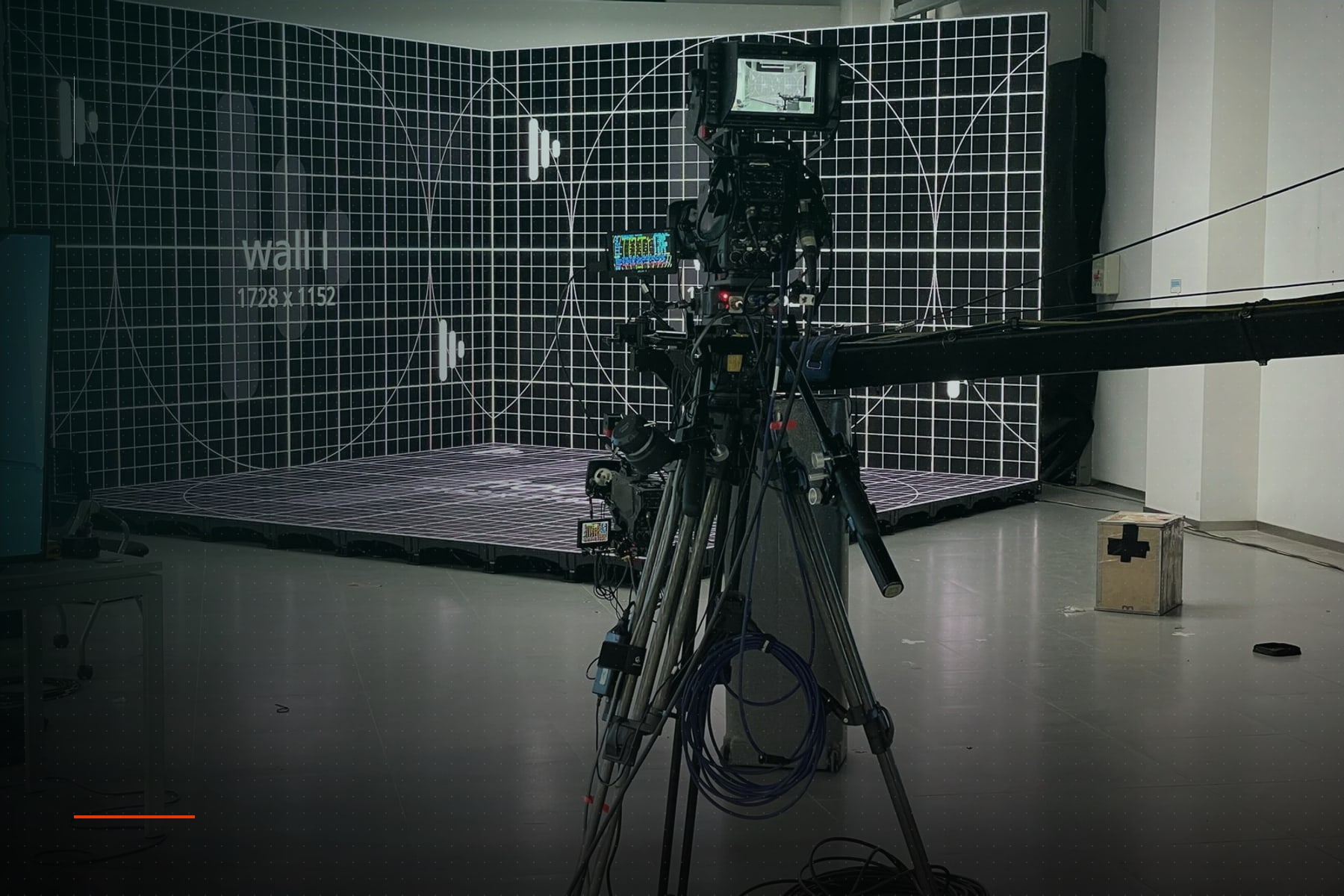
An LED volume replaces the green screen with a wall of real light: the background is rendered in a game engine, tracked to the camera and displayed on LED panels that also light the actors. It is the most demanding use of LED display technology because the wall is judged not by the eye but by a camera sensor at 24 frames per second. This guide explains what makes an LED wall camera-ready, from refresh rate and grey scale to colour gamut, pixel pitch, latency and the physical geometry of ceiling, wall and floor.
The camera sees what the eye forgives
A display that looks flawless to a human can flicker, band and moiré on camera. Virtual production specifies for the sensor: a refresh rate of 7,680 Hz or higher so shutter angles do not catch the scan, grey-scale depth of 16 bits so dark backgrounds do not band, and a pixel pitch matched to the camera-to-wall distance and focal length so the pixel grid never resolves as moiré.
Refresh rate and scan
Scan rate and PWM frequency matter as much as the headline refresh figure. Ask for the effective refresh at low brightness, because most driver ICs reduce PWM depth as they dim, and volumes run dark for night scenes.
Colour science for LED volumes
The wall is a light source and a backdrop at once. Wide-gamut LEDs covering Rec. 2020 or at least DCI-P3, per-cabinet calibration and a stable white point across brightness levels let the director of photography light talent against the wall without colour shifts. Infrared and near-black behaviour matter too: cheap LEDs emit a red tail that cameras see as magenta in shadows. A four-emitter LED (RGB plus white) improves skin tones and the reflected light on set.
In a volume, the LED wall is the location. It has to behave like one.
Pixel pitch and moiré
The rule is that the wall must be out of focus or beyond the resolving power of the lens at the shooting distance. For background walls at four to six metres, 2.3 to 2.9 mm is common; for ceilings, which are rarely in shot and mainly provide reflections, 3.9 to 5.9 mm saves budget; for floors that appear in frame with actors on them, 2.6 to 3.9 mm with a load-bearing cabinet. Test with the production’s actual lenses before signing off the pitch.
Geometry: wall, ceiling and floor
Volumes combine a curved background wall of 180 to 270 degrees, a ceiling for reflections and often a load-bearing LED floor. Each surface has different demands — the floor carries people, dollies and set pieces; the ceiling is lit for bounce; the wall is in shot. A modular platform that supplies all three with matched colour science avoids the seam between products that cameras find instantly.
Curvature and seams
The background wall curves at ±5° to ±10° per cabinet so the frustum can track across it without visible facets. Seam compensation in the processor and mechanical alignment pins keep joints invisible under raking light.
Latency, genlock and processing
Genlock between camera, tracking system, render engine and LED processor keeps the frustum and the background aligned. Total system latency under a few frames is the target; every processing stage — media server, image processor, sending card — must be measured, not assumed. Processors that support HDR pipelines, 12-bit input and frame-remapping for multi-camera shooting are now standard for serious stages.
Specification checklist for an LED volume
- 01Refresh 7,680 Hz or higher with stated low-brightness PWM behaviour.
- 0216-bit grey scale and HDR-capable processing.
- 03Wide gamut (DCI-P3 or better), per-cabinet calibration report, stable white point.
- 04Pixel pitch tested against the production lenses at shooting distance.
- 05Curvature steps, seam compensation and rear service corridor.
- 06Load-bearing floor cabinets rated for dolly loads; ceiling rigging with adjustable trim.
- 07Genlock, measured end-to-end latency and processor redundancy.
Frequently asked questions
What refresh rate does an LED wall need for virtual production?
At least 7,680 Hz, with confirmed performance at low brightness. Lower refresh rates produce scan lines and flicker at cinema shutter angles.
What pixel pitch is used in LED volumes?
Background walls typically use 2.3–2.9 mm, ceilings 3.9–5.9 mm and floors 2.6–3.9 mm, always tested against the actual lenses for moiré.
Why does colour matter more in an LED volume?
The wall lights the actors as well as forming the background, so its gamut, white point and spectral behaviour appear directly on skin and costume.
How large should an LED volume be?
Most feature stages use a 180–270° wall of 6–8 m height and 20–30 m width with a ceiling; smaller studios work with a 10 m flat or gently curved wall for commercials and broadcast.