LED screens for shops and window displays: the digital storefront that sells
A shop window LED screen turns footfall into visits. Poster LED, LED film, hologram glass and fine-pitch walls compared, with content plans, brightness, power and ROI.
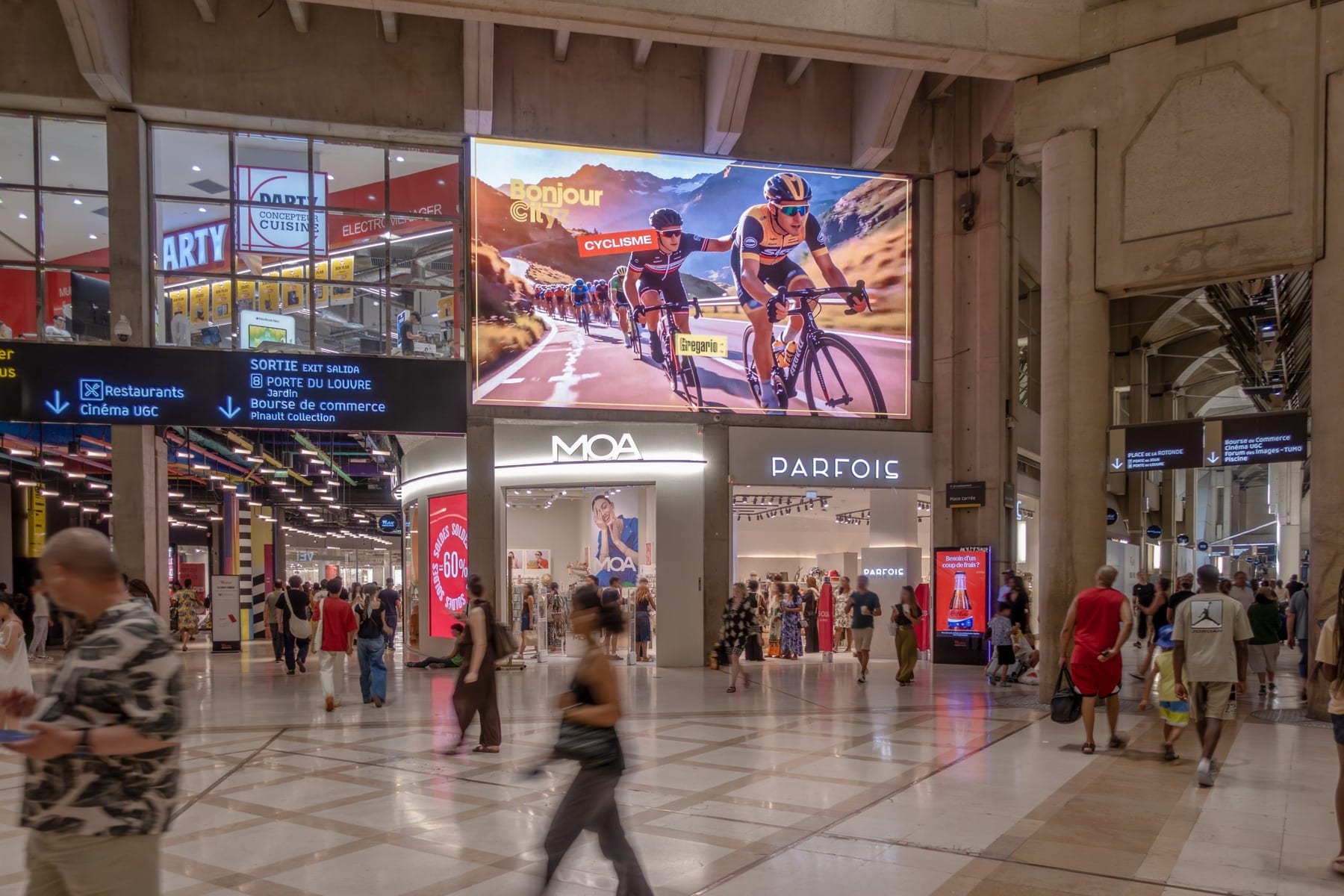
A shop window LED screen turns the one advertising space every passer-by already sees into a moving sales tool instead of a static poster. Footfall at the door, the hours you are open and the rhythm of the street or mall corridor make the window the most valuable media surface most retailers own, and the rent is already paid. This guide explains the four formats of a digital storefront — Poster LED Display, a fine-pitch wall behind the glass, Jellyfish LED Film and Jellyfish Hologram Glass — then covers store-type recommendations, content planning, sunlight and brightness, installation, power and return on investment.
Why the window is your most valuable advertising space
The value of any advertising space is a product of two numbers: how many people pass it and how many hours it is visible. A busy Istanbul high-street window sees 20,000 to 60,000 pedestrians a day; corridor traffic in a large mall passes 30,000 on a weekend. The shop is open for twelve hours, but the window is visible around the clock, and an LED screen keeps playing after closing as long as the shutter stays up. Rented outdoor media stops when the contract does. The window is yours: it works every hour it is lit, and it carries a new campaign the moment you upload one.
A static poster is read once and then the eye moves on. Moving images are caught in peripheral vision: the head turns, the pace slows and a moment of decision opens. Retail studies have repeatedly measured a clear rise in dwell rate in front of digital windows compared with static ones; the figures vary by store, but the direction never changes. That is the job of a retail LED display in the window: convert people passing into people stopping, and people stopping into people walking in.
Four formats for a shop window LED screen
Retail LED display options for a window fall into four formats. They differ in pixel pitch, brightness, transparency and how they install, and the right one depends on the depth of the window, which way the glass faces and whether products will stand behind it. Each is described below with the specifications that matter for a storefront, followed by a quick selection guide.
Poster LED Display: plug in, stand it up, sell
The Poster LED Display is a 640 × 1920 mm portrait LED poster that stands on its own base, hangs from the ceiling or mounts to a wall. Pixel pitches of 1.53, 1.86 and 2.5 mm stay sharp at arm's length, and 600–700 nits is enough for a window bay or the shop floor. It runs from a single socket, takes content by USB or wireless upload, and several posters daisy-chain into one tall image or a synchronised row. With no chasing, no drilling and no electrical design, it is the fastest way into an LED poster window, and it moves with you when the lease ends.
The wall behind the window: XR Fine
If the window is deep and its back wall sits one to three metres behind the glass, the strongest image comes from a fine-pitch LED surface on that wall rather than on the glass. XR Fine builds a seamless wall at 1.5–2.5 mm pitch: products and mannequins stand in front, a moving scene plays behind. Nothing is fixed to the glass; cabinets hang on the wall and are serviced from the front. Because it is also seen from inside, the same wall does double duty as in-store digital signage and window display.
Jellyfish LED Film: a transparent screen bonded to the glass
Jellyfish LED Film is a 2 mm transparent LED film that bonds directly onto existing glazing. At 6.25–10 mm pitch it keeps transparency above 90%, so the products in the window stay visible behind the film while the image appears to float on the glass. Around 1,500 nits reads from the street in daylight. No frame, no drilling, no new glass: for tenants who cannot touch the façade it is the most practical route to a transparent shop window LED screen. Our transparent LED guide compares the technology in detail.
Jellyfish Hologram Glass: the glass that carries the LEDs
Jellyfish Hologram Glass embeds the LEDs and driver chips inside a multi-layer glass unit; the screen is the glass itself. Pitches from 4 to 20 mm and brightness up to 5,000 nits are meant for large south-facing frontages and flagship windows. Panels join seamlessly up to 6 m and follow curved glass. Because it replaces the glazing unit, it belongs in a new build or a full refit, and it delivers the cleanest result: when off, it looks like ordinary glass. Its frameless sibling, the Jellyfish Hologram Display, applies to existing glass without touching the structure.
- 01Tenant who needs to start fast: Poster LED Display, one socket, moves with you.
- 02Deep window with a back wall: XR Fine wall behind the glass, the highest resolution.
- 03Products must stay visible through the glass: Jellyfish LED Film, over 90% transparency.
- 04New façade or flagship with south-facing glass: Jellyfish Hologram Glass, up to 5,000 nits.
Which retail LED display for which store
No two shops want the same screen. The size of what you sell, how long the customer takes to decide and the physical state of the window decide the format. The six scenarios below are the ones that recur most often in Istanbul street and mall projects; treat them as starting points, since a survey of the actual window settles the final choice.
- 01Fashion and apparel: an XR Fine wall behind the window for collection films and campaigns, or two Poster LED Displays beside the mannequins; the content changes with the season, the screen stays.
- 02Jewellery and watches: small products, critical lighting. A single 1.53 mm Poster LED Display behind the trays carries macro footage; transparent film is the second choice because it never shades the pieces.
- 03Phone and electronics stores: fast price and promotion cycles. Two or three daisy-chained Poster LED Displays with central management show the same price in every branch at the same minute.
- 04Car showrooms: large glass, long viewing distance. Jellyfish LED Film or Hologram Glass animates the frontage without hiding the car; inside, an XR Fine wall becomes the configurator screen.
- 05Restaurants and cafés: menus and daypart offers. A portrait Poster LED Display by the door shows breakfast in the morning, the lunch menu at noon and desserts in the evening; no sound.
- 06Pharmacies and cosmetics: information and trust. One Poster LED Display covers duty hours, promotions and seasonal products, dimmed to 30% at night.
The content plan: how many seconds, how many creatives
A pedestrian passes a window in three to five seconds. Every scene on a shop window LED screen should therefore run 6–10 seconds, the main message should read within the first two, and the loop should stay under 30–60 seconds. Three to five creatives are enough in practice: a brand scene, two campaigns, a product focus and, if needed, an information card. Schedule by time of day; the morning passer-by shops differently from the evening one. Food at lunchtime, discounts in the late afternoon and a family offer at the weekend is a simple day-parting that lifts the same screen without new content.
Do not use audio: it is not heard through glass, malls prohibit it and it wears the staff down. The motion rules are plain: large, slow movement, a single focal point, high contrast, and type at least 80–100 pixels tall so it reads from the pavement. Brand consistency makes the screen part of the shop; logo, typeface and colour palette should match the printed window. Content can come from your agency, your own team or Xeron's content team. What matters is a monthly refresh calendar, because a window that has played the same video for six months has turned back into a static poster.
- 016–10 seconds per scene, no more than 60 seconds per loop.
- 02One message, one price, one call to action per scene.
- 03Portrait design for a portrait format; landscape video is not cropped and rotated.
- 04Black backgrounds on film and glass screens: a black pixel is off, and what is behind it shows through.
- 05Night brightness and a night content theme saved as a separate schedule.
A window screen is not a device you buy once; it is a shopfront you rewrite every month.
Sunlight and brightness: the south-facing shop window LED screen
The most common complaint about a window LED screen is that it cannot be seen in daylight, and almost every time the cause is the wrong brightness class. A north-facing window or a mall unit is served by 600–1,000 nits. A south- or west-facing window in direct afternoon sun needs 2,500–4,000 nits, and in that band the answer is Jellyfish LED Film, on the glass at 1,500 nits with little reflection loss, or Jellyfish Hologram Glass at up to 5,000 nits. A standard Poster LED Display in such a window is pulled 1–1.5 m back from the glass, paired with an anti-reflective film, or shaded by an awning.
Reflection is the second problem. The glass lays the opposite pavement and the sky over the image; dark-background content and placing the screen as close to the glass as possible reduce the effect. Automatic dimming from a light sensor saves electricity and extends LED life: full power in daylight, 50% in the evening, 20–30% at night. A screen running at fixed brightness through the night is a nuisance and falls foul of mall and municipal rules.
Installation and power: is one socket enough
For most window installations, yes. A single Poster LED Display draws around 200 W on average and up to about 600 W at peak across its 1.23 m²; a standard 220 V, 16 A socket comfortably feeds three posters. An XR Fine wall behind the window is budgeted at 150–250 W per m² on average, so a 6 m² wall deserves its own circuit. Jellyfish LED Film is the most frugal at 40–170 W per m², but it needs 10–15 cm at the edge of the glass for the edge connector and driver box.
The cable route should be drawn before the window fit-out is finished: the socket under the window floor, cables in trunking, nothing across a walkway. Freestanding posters need tip-over protection; where the base weight is not enough, a hidden fixing to the wall or floor is added. Heat is not a concern, but leave 5 cm of air behind a poster and do not seal a closed volume between screen and glass. Installation typically takes an hour for a poster, half a day for film and one to three days for a wall.
Return on investment: from footfall to walk-ins
The return on a shop window LED screen is measured through a four-step funnel: pass, stop, enter, buy. Take a street store with 10,000 pedestrians a day. If 1% stop at a static window, that is 100 people; if the digital storefront lifts that to 2%, it is 200. If 15% of them walk in, that is 30 visitors instead of 15; at 20% in-store conversion, six sales a day instead of three. Read those as counts, not sums: three extra sales a day is about ninety a month, and 450 extra visitors through the door. What an average basket is worth in your shop is yours to know.
Measure before you install or the comparison afterwards means nothing. Count the pedestrians passing the window for a full week, log entries with a door sensor, and pull the same week from the till: number of transactions, items per transaction, and the hours of the day they cluster in. Repeat the count four weeks after the screen goes live and again in the following season, with the same method and the same days of the week. Weather, holidays and a neighbouring closure move these numbers as much as the screen does, so read the trend across weeks rather than a single good Saturday.
Beyond the screen itself, three lines recur every year: electricity, content production and maintenance. Electricity is predictable from the power figures above and falls further with sensor dimming. Content is the line most retailers underestimate, because a monthly refresh needs someone who owns the calendar, whether that is your team, your agency or ours. Maintenance on a window installation is light: a spare power supply and receiving card on the shelf, an annual clean of the surface and the connectors, and a check that the schedule still matches your opening hours.
Mall rules: management approval and brightness limits
In a mall unit, a window LED screen is subject to the mall management's approval, not just the store's. Most mall window design guides define digital displays explicitly: a brightness ceiling on the corridor-facing surface (usually 800–1,500 nits), no audio, no flashing or fast-cut content, limits on fixing to the shopfront and a review of the electrical work by the mall's technical team. The application file carries the screen's dimensions, position, brightness, power draw and sample content. Poster LED Display and Jellyfish LED Film pass this process most easily because neither permanently alters the frontage. On the street, the municipal signage regulation and the shutter line apply instead.
A checklist before you start
- 01Which way the window faces and whether it takes direct sun during the day.
- 02Glass dimensions, window depth and whether there is a back wall.
- 03The nearest socket and a route where the cable can be hidden.
- 04Documents needed for mall or municipal approval.
- 05A content calendar for the first three months and who will produce it.
- 06Baseline numbers to measure before installation: daily footfall, entries, sales.
Xeron handles store and showroom projects in Istanbul from survey to installation and content calendar. Share the size and orientation of your window and we will show, in a proposal written for that window, which format makes sense at which brightness and at which size, and what the first three months of content could look like. A short brief on the Start a Project page is all it takes.
Frequently asked questions
How much does a shop window LED screen cost?
Xeron quotes each window as its own project, so there is no list figure to give here. What moves the number is the surface area, the pixel pitch, the brightness class your glass orientation demands, the mounting method, and whether content production and maintenance are included. Send the dimensions of the glass and a photo of the window and you get a written proposal for that window.
What is an LED poster?
An LED poster is a slim 640 × 1920 mm portrait LED display that stands on its own base or hangs from a ceiling and runs from a single socket. Pixel pitches of 1.53–2.5 mm give a sharp image at close range; content loads by USB or wireless, and several posters chain into one image. It is the fastest digital storefront format to install for shops, lobbies and exhibitions.
Can an LED screen be seen in a sunlit window?
Yes, if the right brightness class is chosen. A south- or west-facing window in direct sun needs 2,500–4,000 nits, which points to Jellyfish LED Film applied to the glass or Jellyfish Hologram Glass at up to 5,000 nits. A standard 600–700 nit Poster LED Display works in shaded windows when pulled 1–1.5 m back from the glass, with dark-background content and an anti-reflective film.
Can LEDs be mounted on glass?
Yes, in two ways. Jellyfish LED Film is a 2 mm adhesive film that applies directly to existing glass, keeps transparency above 90% and needs no new glazing. Jellyfish Hologram Glass is a new glass unit with the LEDs embedded inside it; it gives the cleanest look but is planned together with a façade refit. In both cases the products in the window remain visible.
Who produces the content for a window screen?
There are three options: the store's own design team, the advertising agency you already work with, or Xeron's content team. Whoever produces it, the same rules apply: portrait design to the screen's pixel dimensions, 6–10 seconds per scene and one message per scene. A starter pack of three to five creatives is prepared with the installation, and a monthly refresh calendar keeps the screen alive.
How much electricity does a window LED screen use?
A single Poster LED Display draws around 200 W on average and up to 600 W at peak; running twelve hours a day, that is roughly 70–80 kWh a month. Transparent LED film averages 40–170 W per m² and a fine-pitch wall behind the window 150–250 W per m². Automatic dimming from a light sensor cuts night-time consumption by 60–70%.