How to size an LED screen for an event: weddings, concerts, trade fairs and launches
How big should an LED wall be? Stage LED screen size from the farthest seat, cabinet modules, aspect ratio and pixel pitch, with sizes for weddings, concerts and fairs.
Stage LED screen size is the most expensive and least reversible decision in an event budget: square metres, cabinet count, processing, rigging and trucking all follow from it. Yet most organisers guess the size from the budget or from a photograph of the room. The right size is calculated from three numbers: the farthest viewer, the nearest viewer and the content you will show. This guide gives the rule for weddings, corporate launches, concerts, trade-fair stands and panel discussions, rounds the worked examples to cabinet modules, and explains what the chosen size means for pixel pitch, weight and power.
The three numbers behind stage LED screen size
The first number is the distance from the screen to the farthest viewer: the last table in a ballroom, the back row of a conference hall, the end of the standing area at an outdoor concert. The second is the nearest viewer, because pixel pitch is set by proximity, not by distance. The third is the content type: full-frame video, text-heavy presentation slides, live camera and a decorative logo loop all read differently from the same seat on the same screen. Any size quoted without these three numbers is a guess.
- 01Farthest viewer: measure it from the floor plan or pace it out, and take the worst case before the seating plan is final.
- 02Nearest viewer: the front of stage, the head table or, at a trade fair, the aisle; this value sets the pixel pitch.
- 03Content type: moving video, text-heavy presentation, live camera (IMAG) or a purely decorative backdrop.
The height rule: farthest distance divided by 8
The most useful starting rule for stage screens ties screen height to the farthest viewing distance. For video and image-led content the screen height should be one eighth of the farthest distance; for presentations with text and tables, one sixth. The rule gives height rather than width because the eye judges legibility by vertical angle; width is then derived from the aspect ratio. These ratios come from cinema and auditorium design and work the same way for LED. They describe what the audience needs, not what the budget allows.
Worked example: a 20 m hotel ballroom
In a wedding venue where the last table sits 20 m from the stage, video needs 20 / 8 = 2.5 m of height. At 16:9 the width is 2.5 × 1.78 = 4.4 m, which rounds to cabinet modules as 4 × 2.5 m. The same room hosting a corporate dinner with text-heavy slides needs 20 / 6 = 3.3 m, so 3.5 m high and 6 m wide. Same room, same distance; a change of content nearly doubles the screen.
Worked example: a 56 m outdoor field
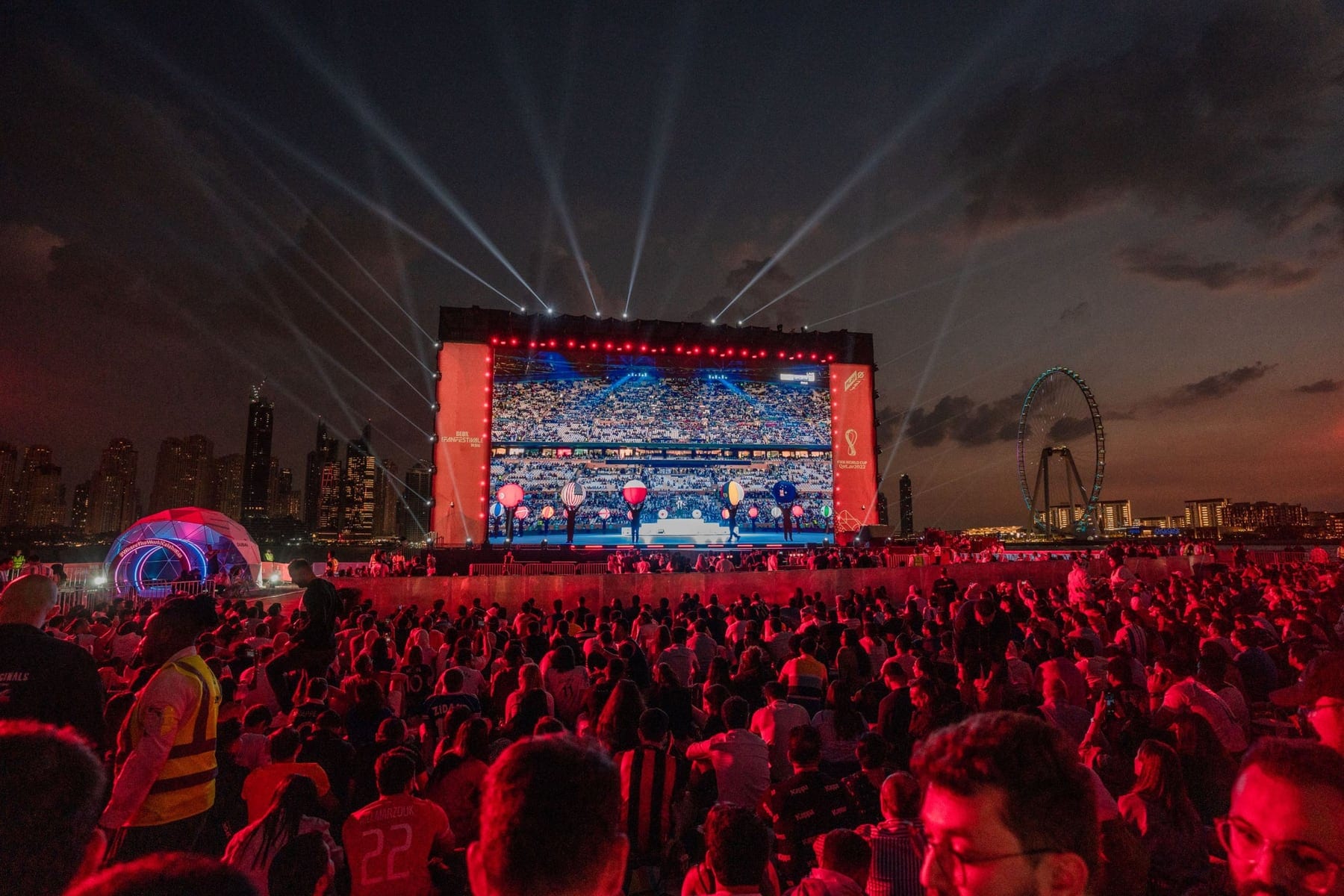
At an outdoor concert for five thousand people where the field ends 56 m from the stage, 56 / 8 = 7 m of height gives about 12.4 m of width at 16:9, which rounds to 12 × 7 m. There is no case for shrinking this: at a festival, the audience at the back sees the artist only on the screen. The rule states the real need. If it does not fit the budget, the correct response is to add side screens or move to a coarser pixel pitch, not to make the main screen smaller.
Rounding to cabinet modules: 500 × 500 and 500 × 1,000 mm
Rental LED screens are built from 500 × 500 mm and 500 × 1,000 mm cabinets, so sizes come in multiples of half a metre. A 6 × 3.5 m screen is 12 × 7 = 84 cabinets of 500 × 500 mm, or 12 columns of 500 × 1,000 mm cabinets with a half-height row at the bottom. A 4 × 2.5 m screen is 8 × 5 = 40 cabinets; a 12 × 7 m concert screen is 24 × 14 = 336. Talking in cabinets rather than metres is the quickest way to share a language with the supplier.
A size such as 5.3 × 3.2 m, which does not land on the module, is either grown to the next module or finished with masking, a frame and cropped content. The second route costs more: custom-cut cabinets, content trimmed at the edges and a longer build. At an event the right decision is almost always to round up. The resolution handed to the content designer is also derived from the rounded size; if content is not produced for the screen's real pixel count, edges are cut or the image is stretched.
Aspect ratio and content: 16:9 or ultra-wide
16:9 is the safe ratio because cameras, presentation software and video sources all produce it. For weddings, panels and most launches, 16:9 or something close to it carries the content with no adaptation at all. Launches and concerts often use 32:9 or wider backdrops that span the whole stage, place the presenter inside the picture and look more striking than a single rectangle. An ultra-wide screen, however, demands custom content: a 16:9 video on a wide screen either leaves empty bands at the sides or gets cropped.
Resolution is the product of size and pixel pitch. A 6 × 3.5 m screen gives 2,304 × 1,344 pixels at P2.6 and 1,536 × 896 at P3.9; the first carries Full HD content pixel for pixel, the second scales it slightly, which is invisible from 28 m. A 12 × 7 m concert screen at P3.9 is 3,072 × 1,792 pixels and uses a 4K source scaled. Give the designer the screen's pixel dimensions at least two weeks before the event; producing content for the screen is far cheaper than enlarging the screen for the content.
Stage LED screen size by event type
The examples below apply the rule to typical venues; each gives the farthest distance, screen size, cabinet count and pixel pitch. If your venue differs, change only the farthest distance and rerun the calculation. The sizes are starting points for a quotation, not a substitute for a site visit.
Wedding: 200 guests, hotel ballroom
With the last table 18–20 m away, a 4 × 2.5 m screen (8 × 5 cabinets, 10 m²) is enough; P2.6 is chosen because the head table sits 3 m from the stage. A wedding screen shows live camera, a photo slideshow and decorative animation in turn, and 16:9 carries all three. A 3 × 2 m screen usually looks small in a 300-guest room, while a 5 × 3 m screen overpowers the stage and steals the background in every photograph of a 200-guest room.
Corporate launch: 500 guests, conference hall
With the back row at 28 m, the main screen is 6 × 3.5 m (12 × 7 cabinets, 21 m²); P2.6 for front rows that will study product detail, P3.9 if the budget is tight. Launches usually add two side screens of 3 × 2 m at P2.6 so that the presenter's camera feed and the slides each have their own surface. Brand colours depend on processor calibration and a white balance done with the stage lighting on; our rental LED screen setup guide lists those checks.
Concert: 5,000 people, outdoor
With the field ending 56 m away, the main screen is 12 × 7 m (24 × 14 cabinets, 84 m²) plus two side screens of 6 × 4 m (12 × 8 cabinets, 24 m² each); P3.9 on the main screen, P3.9–P4.8 on the sides. The crowd at the barrier stands 6–8 m from the screen, so nothing finer is needed. Outdoors, 4,000–5,000 nits and IP65 cabinets are mandatory; XR Arena and XR Event are our rental series built for stages of this scale. Wind load and rigging calculations matter as much as the screen weight at this size.
Trade fair stand: 3 × 3 m at CNR Expo or Tüyap
At a fair the farthest viewer is across the aisle at 6–8 m and the nearest is inside the stand at 1–1.5 m, so the stand wall, not the distance, sets the size. A 3 × 2 m screen (6 × 4 cabinets) fits the back wall of a 3 × 3 m stand, and the aisle-side proximity calls for P1.9 or P2.6. Where a wall screen exceeds the budget, two Poster LED Display units or an XR Column in the corners are both more portable and cheaper. A fair screen loops product video; 800–1,000 nits is enough under hall lighting.
Panel and conference: 150–300 seats
Panel content is text-heavy: speaker names, slides, charts. With the back row at 22 m, 22 / 6 = 3.7 m suggests 3.5–4 m of height and 6–7 m of width; if the stage height does not allow it, a 5 × 3 m main screen with two 2 × 1.5 m side screens works better. Pixel pitch is P2.6 if the front row sits 4 m away. Type below 12 point cannot be read from the front rows at any pitch; that problem is solved by the content, not the screen.
Backdrop screen or side screens
The backdrop screen is the set: brand, animation, atmosphere. Side screens (IMAG, image magnification) show the magnified person on stage and are needed at almost every event above 300 people, because a camera feed sent to the back wall sits directly behind the speaker. The rule is simple: the backdrop carries content, the side screens carry the camera. Side-screen height follows the same divide-by-8 rule, but with the farthest viewer's distance to that side screen; in practice it is about half the height of the main screen.
The room sets the screen size; the budget only changes the pixel pitch and the number of side screens.
Pixel pitch from the nearest viewer
The ten-times rule from our pixel-pitch guide applies here too: the pixel pitch in millimetres equals the minimum comfortable viewing distance in metres. P2.6 reads cleanly from about 2.6 m and P3.9 from about 3.9 m; the best picture is seen at two to three times that distance. If the front of stage is 3 m away, P2.6 is right; at 5 m, P3.9 is enough; at 8 m, P4.8 makes no visible difference. Halving the pitch quadruples the LED count and raises the rental noticeably, so choose the pitch as tight as the nearest viewer requires and no tighter.
Indoors, XR Essential and XR Flex build wedding, launch and panel screens at 1.9–3.9 mm, and the locked curve angles of XR Flex serve curved backdrops. For outdoor concerts, XR Arena and XR Event come at 2.6–4.8 mm with IP65 cabinets and high brightness. Where performers walk on the screen, XR Floor adds load-bearing cabinets to the same system. The series does not change the size: the same 6 × 3.5 m screen is the same number of cabinets whichever series builds it.
Stage height, sightlines, rigging and ground stacking
The bottom edge of the screen should sit at least 1.2–1.5 m above the stage floor; otherwise a standing presenter, the front tables and the floral arrangements hide the lower third of the picture. That height comes out of the ceiling: in a ballroom with a 5 m ceiling, a 0.8 m stage, 1.2 m of clearance and a 3 m screen add up to 5 m, leaving no room for rigging. In low rooms the height rule has to give way and side screens make up the difference.
A screen is either flown from truss or ground-stacked from the floor. Ground stacking shortens the build and lowers the cost, but above three rows of 500 × 1,000 mm cabinets it needs rear bracing and ballast, and it takes stage depth. Flying clears the sightlines and is the only sound method at large sizes; ceiling load, rigging-point certificates and a rigger's sign-off are planned as early as the size itself. Outdoors, a 7 m high screen is not built without a wind-load calculation.
Weight and power for the chosen stage LED screen size
Once the size is fixed, weight and power follow almost automatically. A rental-grade 500 × 500 mm cabinet weighs about 7–9 kg and a 500 × 1,000 mm cabinet 14–18 kg, with header bars, cabling and the processor on top. Average power draw is 150–250 W/m² indoors and 250–400 W/m² outdoors, with peaks of roughly two to three times that. The venue's electrical supply is planned for the peak; whatever remains goes to lighting and sound.
- 014 × 2.5 m (10 m²) wedding screen: 40 cabinets, about 320–360 kg, 2–2.5 kW average, 5–6 kW peak.
- 026 × 3.5 m (21 m²) launch screen: 84 cabinets, about 700 kg, 4–5 kW average, 10–12 kW peak.
- 0312 × 7 m (84 m²) outdoor concert screen: 336 cabinets, about 3 tonnes, 25–30 kW average, up to 60 kW peak; side screens not included.
- 043 × 2 m (6 m²) trade-fair screen: 24 cabinets, about 200 kg, 1–1.5 kW average; runs from a single-phase 16 A supply.
Rental is priced per square metre per day, and the market bands for indoor P2.6–P3.9 and outdoor P3.9–P4.8 vary by up to double depending on whether build, processing and a technician are included. Compare quotes only when screen size, cabinet count, pixel pitch and scope are identical; our LED screen rental guide covers the questions to ask before signing.
Send us the distance to your last row, the distance to the front of stage and the content you plan to show; the Xeron team rounds the size to cabinet modules and returns a proposal with pixel pitch, rigging and power. The short form on the Start a Project page is all it takes.
Frequently asked questions
How big should an LED wall be for a wedding?
Divide the distance from the stage to the last table by 8: a 20 m room needs 2.5 m of height, which at 16:9 is a 4 × 2.5 m screen. Rooms of 100–150 guests typically take 3 × 2 m and large 300-guest ballrooms 5 × 3 m. Choose P2.6 if the head table sits 3 m away; a finer pitch adds nothing at a wedding.
What is the best LED screen size for a trade-fair stand?
A 3 × 2 m screen fits the back wall of a 3 × 3 m stand, and because visitors watch from 1–2 m in the aisle it needs a P1.9–P2.6 pitch. In smaller stands or on a tight budget, a 640 × 1,920 mm Poster LED Display or an XR Column sits in a corner, installs in an hour and travels from fair to fair.
What does a 500 × 500 cabinet mean?
Rental LED screens are built from 500 × 500 mm or 500 × 1,000 mm aluminium cabinets, each carrying its own modules, power supply and receiving card. Screen sizes therefore come in multiples of half a metre: a 4 × 2.5 m screen is 8 × 5 = 40 cabinets. A P2.6 cabinet holds 192 × 192 pixels and a P3.9 cabinet 128 × 128.
What happens if the screen is too big?
The front rows turn their heads to take in the whole picture, faces in the camera feed grow to an unnatural scale and the person on stage disappears in front of the screen. Cabinet count, weight, power and rental cost also rise for no benefit. Do not exceed the height rule by more than 20 percent; anything beyond that is a decorative choice and should be budgeted as one.
Is P3.9 enough for a concert?
Yes. At outdoor concerts the barrier is 6–8 m from the screen and P3.9 reads cleanly from about 3.9 m; a 12 × 7 m main screen at P3.9 gives 3,072 × 1,792 pixels. In indoor arenas and club shows where the front of stage is 3 m away, P2.6 is preferred, and P4.8 is enough for side screens viewed from the back.
What information do I need to work out stage LED screen size?
Three numbers are enough: the distance from the screen to the farthest viewer, the distance to the nearest viewer and the content type (video, presentation or live camera). Add the ceiling height, the stage height and whether rigging is possible, and the size, pixel pitch and build method can be settled in one meeting. A floor plan and a few photographs speed up the calculation.