LED screens for pharmacies, clinics and jewellers: which format, what size and which rules apply
A pharmacy LED screen, a clinic display and a jewellery window LED each follow their own rules: format, pitch, brightness, size, permitted content and installation.
A pharmacy LED screen has a different job from the screen in a fashion window, and so do a clinic's and a jeweller's. The pharmacy has to be found from far down the street, the clinic has to look calm and trustworthy without breaking the rules on health promotion, and the jeweller has to make small objects shine without being outshone by the screen. This guide covers the job of each window, the right format, pitch by distance, brightness and glare on glass, sizes for a 2–3 m frontage with worked examples, the promotion rules in Turkey, installation and power, and the most common mistakes.
Why these three windows follow different rules
Most shop window guides assume a retailer who is free to advertise anything, as loudly as the street allows. Pharmacies and clinics are not. Both operate under professional rules that limit what may be promoted and how, and both sit in neighbourhoods where the municipality watches illuminated signage closely. Jewellers are free to advertise, but they sell objects a few centimetres across whose entire appeal rests on light, so the wrong screen quietly damages the product it is meant to support. The three share a frontage of two to three metres, a pavement audience and a small budget of attention, which is why they belong in one guide.
What a pharmacy LED screen has to do
A pharmacy window has three tasks, in a strict order of importance. First, be found: a person walking a street at night with a prescription in hand, or a parent looking for the duty pharmacy at two in the morning, scans the street from 30–50 m away and needs to spot the pharmacy before reading anything. Second, tell them the status: open, closed, on duty tonight, or which nearby pharmacy is on duty instead. Third, and only third, inform and promote within the limits the rules allow: opening hours, services such as blood-pressure measurement, seasonal health information, and campaigns on the product categories that may be promoted.
Being found from 30–50 metres
At that distance a passer-by does not read; they recognise. The pharmacy cross and the word Eczane in large, high-contrast type are what register, and the screen's job is to make them larger and brighter than the printed sign next door can be. This is a task for a high-brightness surface at the top of the glass, in a landscape strip, with type at least 20–25 cm tall. It is not a task for fine detail, which is why a transparent film with a coarse pitch, unusable for a jeweller, is exactly right for a pharmacy.
Duty status, campaigns and health information
The official duty plate and lit sign are regulated separately, and the LED screen complements them rather than replacing them. What the screen adds is clarity: a full-glass duty scene tonight, and on other nights the name and street of the pharmacy that is on duty, updated from the chamber's list. Below that come the daypart messages: hours, the services offered inside, a seasonal reminder about vaccination or sun protection, and campaigns on the categories current rules allow, typically cosmetics, dermocosmetics, baby care and similar non-medicinal ranges, presented without health claims.
The clinic window: a calm presence behind glass
A clinic digital display sells nothing directly. Its job is to make the practice look competent and settled, to list the services offered, and to reassure a patient who has already decided to come in that they have the right door. That argues for calm content: the clinic name, the specialties, the doctors' names and titles as licensed, opening hours, the appointment line, and slow, wide imagery in the brand colours. It argues against fast cuts, countdowns and anything that reads as a sale, which is not only bad taste in a health setting but usually outside what health promotion rules permit.
Privacy is the second requirement. A screen mounted behind reception glass can double as a visual barrier: a fine-pitch wall between the pavement and the waiting area shows the street a branded surface and shows the waiting room nothing at all. Before-and-after imagery, patient stories and any content that identifies a patient stay off the window; where a treatment result may be shown at all under current rules, it belongs in the consultation room, not on the street. The window is for orientation and trust, and a clinic that treats it that way looks more professional, not less.
The jeweller's window: make small objects shine, never outshine them
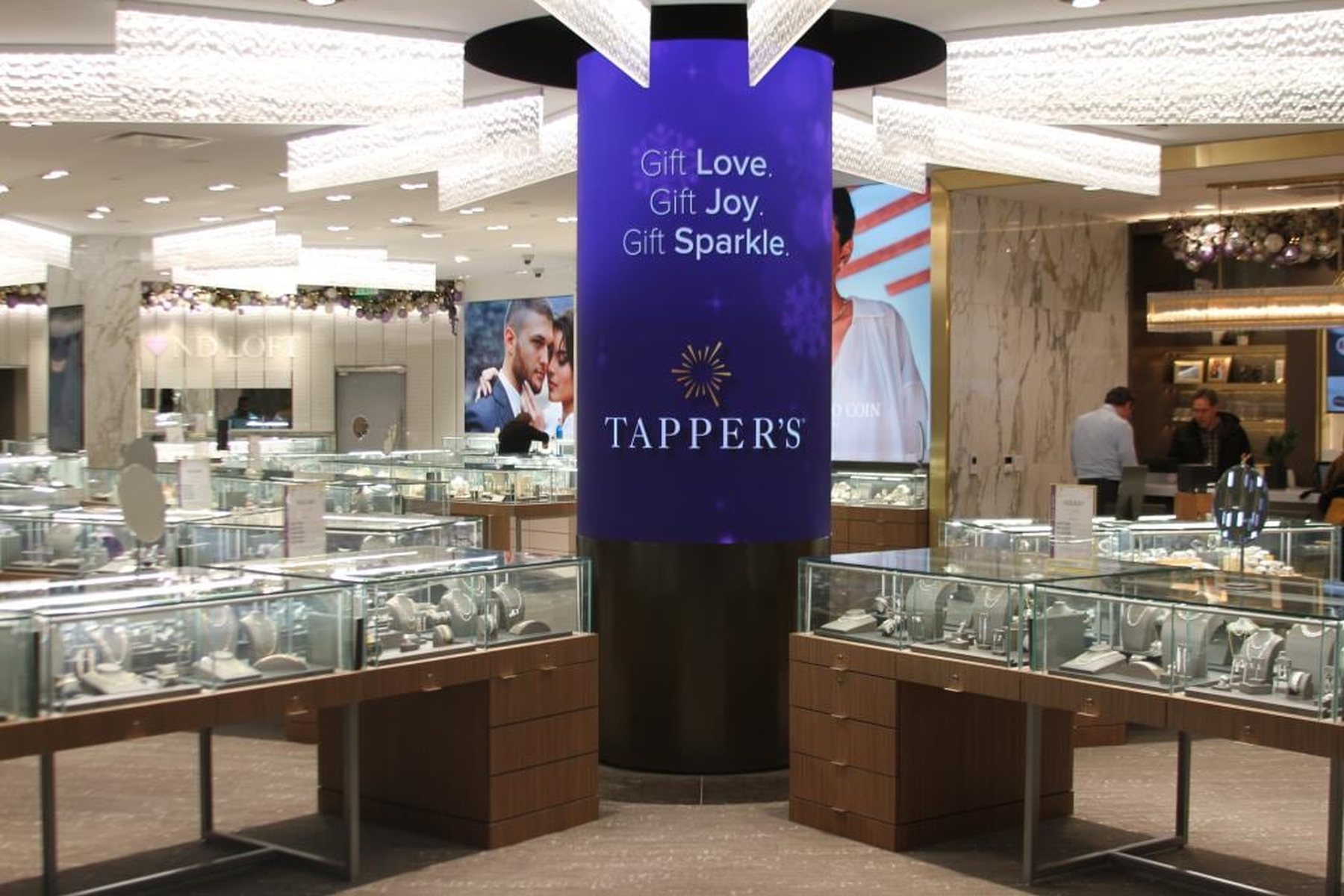
A jewellery window LED sits in the hardest lighting environment on the street. The product is a few centimetres across, its appeal is a play of reflections, and the display lighting has been tuned by hand to make stones sparkle at 3,000–4,000 lux on the tray. Put a bright screen in the same line of sight and the eye adapts to the screen, the tray looks dim and the stones stop sparkling. So the screen has one rule above all: it must never be brighter than the product. In practice it sits beside or above the trays, plays dark-background macro footage and runs at 30–40% of its rated brightness.
- 01Position: flanking the central display or above it, never directly behind a tray in the customer's line of sight.
- 02Brightness: 30–40% of rated output during the day, 10–15% at night, always below the tray lighting.
- 03Content: macro footage of the pieces on a black or deep-coloured background, slow movement, no white flashes.
- 04Security: the screen must not block the CCTV sightline to the trays or the shutter, and night content should not show stock that is not actually in the window.
Which format for which window
Four Xeron formats cover these three business types, and they differ mainly in pixel pitch, brightness, transparency and how much of the window they take. A Poster LED Display stands in the window and needs one socket. Jellyfish LED Film bonds onto the glass and keeps it transparent. A small XR Fine wall behind the glass gives the sharpest image on a back wall. A Jellyfish Hologram Display floats a single hero object in mid-air. The short profiles below say where each one fits; the selection list at the end matches them to the three windows.
Poster LED Display standing in the window
The Poster LED Display is a 640 × 1,920 mm portrait panel on its own base or a wall bracket, at 1.53, 1.86 or 2.5 mm pitch and 600–700 nits. It needs no work on the glass and moves with you when the lease ends. For a jeweller it is the first choice at 1.53 mm, because macro footage of a ring needs that resolution at arm's length. For a pharmacy it works as a second, lower-brightness screen at eye level beside the door, carrying hours, services and campaigns while the film on the upper glass does the long-distance work.
Jellyfish LED Film on the glass
Jellyfish LED Film is a 2 mm transparent film bonded onto existing glazing, at 6.25–10 mm pitch, above 90% transparency and around 1,500 nits. It is the pharmacy format: it reads across the street and from the far end of the block, it leaves the shelves behind it visible, it survives a south-facing window, and it goes on and comes off without touching the façade, which matters to a tenant. Its coarse pitch is no drawback for large type and simple symbols. A clinic with a wide, sunlit frontage uses it the same way, in a narrower strip.
A small XR Fine wall behind the window
Where the window has a back wall or a reception partition 1–3 m behind the glass, an XR Fine wall at 1.5–2.5 mm pitch gives the cleanest image of all, and nothing touches the glass. This is the clinic format: a 1.5 × 2 m surface behind reception glass carries the calm brand scene and the service list, and at the same time hides the waiting area from the street. Jewellers with a deep window use a smaller XR Fine panel as a backdrop for the central display, again at reduced brightness.
Jellyfish Hologram Display for one hero product
The Jellyfish Hologram Display is a frameless transparent panel that applies to existing glass and shows a single object floating in the window with the shop still visible behind it. For a jeweller it is a way to present one piece, a new collection's signature ring or a watch, larger than life and slowly rotating, without a physical tray. It is a supporting act rather than the main screen, and it earns its place when the shop wants one object to stop people rather than a stream of messages.
- 01Pharmacy: Jellyfish LED Film across the upper glass, optionally one Poster LED Display at eye level for hours, services and campaigns.
- 02Clinic: an XR Fine wall or a single large panel behind reception glass; Jellyfish LED Film in a strip only on a wide, sunlit frontage.
- 03Jeweller: one or two Poster LED Displays at 1.53 mm flanking the display; a Jellyfish Hologram Display for one hero piece; never a bright surface behind the trays.
Pixel pitch by distance, brightness and glare on glass
Pixel pitch is chosen from the viewing distance, not from the catalogue. A workable rule is that the pitch in millimetres roughly equals the closest comfortable viewing distance in metres, and text needs at least 10–12 pixels of height to be legible. A pharmacy strip read from across the street at 15–50 m works at 6.25–10 mm; a 20-pixel word at 10 mm pitch is 20 cm tall and reads from 50 m. A clinic screen seen from the pavement at 3–6 m wants 1.86–2.5 mm. A jeweller's macro footage at arm's length needs 1.53 mm, where a 1,920 mm poster carries about 1,250 rows of pixels.
Brightness follows the glass. A north-facing or shaded window is served by 600–800 nits; a south- or west-facing window in afternoon sun needs 1,500 nits or more, which is what the film on the glass provides. Glare is the price of glass: the pane lays the opposite pavement and the sky over the image, and the closer the screen sits to the glass, the less of that reflection the viewer sees. Dark backgrounds help, an anti-reflective film helps, and automatic dimming is not optional. A pharmacy screen at full brightness at three in the morning annoys the flats above and invites a municipal complaint.
Sizes for a 2–3 m frontage: three worked examples
A typical Istanbul pharmacy, clinic or jeweller occupies a shop with a frontage of two to three metres, a glass height of 2.2–2.6 m and a door to one side. The three examples below are sized for that frontage and give the glass dimensions, pixel count and brightness setting together, so content design can start the same day. They are starting points: a survey of the actual glass, its orientation and the shelves settles the final dimensions, and Xeron draws the layout to scale before anything is ordered.
Pharmacy: a 2.4 × 1.2 m film on the upper glass
Take a window 2.6 m wide and 2.4 m high. A Jellyfish LED Film of 2.4 × 1.2 m at 10 mm pitch sits on the upper half of the glass, above 1.5 m, so the shelves stay clear and the strip reads over parked cars. That is 240 × 120 pixels: enough for the cross, the word Eczane at 60 px and a second line at 24 px, 24 cm tall and legible from 50 m. At night the scene switches to duty status at 20–30% brightness; by day it runs hours and services, and a Poster LED Display beside the door adds the campaign layer.
Jeweller: two posters flanking the central display
Take a 3 m frontage with the main display, 1.6 m wide, in the centre. Two Poster LED Displays of 640 × 1,920 mm at 1.53 mm pitch stand either side, 20–30 cm back from the glass, each showing 418 × 1,254 pixels of slow macro footage on a black ground at 35% brightness. The trays stay the brightest thing in the window. One poster may be replaced by a Jellyfish Hologram Display carrying the season's hero piece. At closing the posters switch to a dark brand scene at 10% and the shutter comes down in front of everything.
Clinic: a 1.5 × 2 m screen behind reception glass
Take a ground-floor clinic whose reception sits 1.5 m behind a 2.5 m wide window. An XR Fine surface of 2 × 1.5 m at 1.86 mm pitch, around 1,075 × 806 pixels, hangs on the partition behind reception, visible from the pavement at 3–6 m and from inside the waiting area. It carries the clinic name, specialties, doctors' names and titles, hours and the appointment line in slow rotation, at 500–600 nits by day and 150 at night, and it hides the waiting area from the street. Nothing is fixed to the glass, so the landlord's consent is simpler.
The rules: what a pharmacy LED screen may and may not show
This section describes the principles in general terms; the regulations change, the chambers issue their own guidance, and the final word belongs to your pharmacists' chamber or the provincial health directorate. In Turkey, pharmacies operate under the regulation on pharmacists and pharmacies, and health institutions under the Ministry of Health's rules on promotion. The common thread is that a pharmacy and a health facility may inform but may not advertise in the commercial sense. Comparative claims, price advertising, superlatives, discounts on medicines and anything that draws patients from one provider to another are outside the line.
The limits in general terms
Prescription medicines may not be promoted to the public at all, on any medium, and in Turkey that restriction extends in practice to human medicinal products generally, so a medicine never appears on a pharmacy screen as a campaign. Health services may not be advertised with patient testimonials, guarantees of results, before-and-after images or comparative claims; a clinic may state what it does, who does it and where, in the terms of its licence. Signage itself is regulated: the pharmacy cross and the standard lit sign follow the chamber's standards for form, colour and size, and the screen may not imitate or replace them.
What is still allowed
- 01Opening hours, the duty schedule and the name and address of the pharmacy on duty tonight, taken from the chamber's list.
- 02Services offered inside: blood-pressure and glucose measurement, vaccination where licensed, compounding, medical devices, mother and baby care.
- 03General health information without a product tie: seasonal advice, first-aid reminders, public health campaigns.
- 04Product categories rather than medicines: dermocosmetics, sun care, baby care, oral care, supplements and medical devices, with campaigns on them where current rules permit and without health claims.
- 05For clinics: name, specialties, doctors' names and titles, hours, appointment line and the services in the licence, with no testimonials, results or comparisons.
Municipal signage and light rules
A screen inside the window, behind the glass, is not a façade sign in most municipal regulations, but it is illuminated advertising and the district and metropolitan rules on advertising and signage still apply: no flashing or strobing, brightness that does not disturb the flats above, no content that resembles a traffic signal, and in some districts a night-time reduction or switch-off after a set hour. A film bonded to the glass sits closest to the line and is worth clearing in writing. Xeron prepares the technical sheet with dimensions, brightness and sample content for these applications.
A content plan that respects the limits
For a pharmacy, plan the loop around status first and promotion last. Scene one is identity: the cross, the name, open or closed. Scene two is duty status, tonight's or the neighbour's. Scene three is services. Scene four is a seasonal health message. Scene five, if any, is a permitted campaign on a non-medicinal category. Each scene runs 8–10 seconds, the loop stays under a minute, and the night schedule drops the campaign entirely and dims to 20–30%. Nothing on the screen names a medicine, quotes a price or compares the pharmacy with another.
In a pharmacy window the screen is not there to sell; it is there to be found.
A clinic loop is shorter and slower: a brand scene, the service list, the team as licensed, hours and appointment line, and perhaps a general health message. Ten to fifteen seconds a scene, muted colours, no countdowns. A jeweller's loop is different again: three or four pieces in macro, each held for 10–12 seconds on a dark ground, a short brand scene, and a collection name. In all three, someone owns the monthly refresh, the duty list is updated on time, and expired campaigns come off the day they end. Our content guide covers scene timing and type sizes in more detail.
Installation and power in an existing shop
None of the three needs building work. A Poster LED Display draws around 200 W on average and up to 600 W at peak from a standard 220 V, 16 A socket; a 2.4 × 1.2 m Jellyfish LED Film draws 120–500 W depending on content and needs 10–15 cm at the edge of the glass for its edge connector and driver box; a 3 m² XR Fine surface is budgeted at 450–750 W and deserves its own circuit. Installation takes an hour for a poster, half a day for film and one to two days for a small wall, scheduled outside opening hours.
Three shop-specific points. In a pharmacy the medicine refrigerator and its alarm stay on their own circuit; the screen never shares it. In a jeweller the film or poster must not cross the alarm loop on the glass, and installation is coordinated with the security contractor so sensors and cameras keep their sightlines. In a clinic the wall behind reception is checked for cabling and plumbing before brackets go in, and the screen's controller sits in reception, not in a consulting room. Our installation guide walks through survey, cabling and commissioning step by step.
Common mistakes
- 01Full brightness all night: the most frequent complaint from neighbours and the fastest route to a municipal warning.
- 02A screen brighter than the jewellery trays, so the stones look dull and the screen looks great.
- 03Naming or showing a medicine in a campaign scene, or repeating a supplier's advert unchecked.
- 04Treating the screen as the duty sign: the official plate and lit sign are separate and still required.
- 05Covering the whole glass with film so the shop looks closed and the shelves disappear.
- 06Twelve-pixel type on a 10 mm film that nobody can read from the pavement.
- 07No owner for the content calendar, so the summer campaign is still playing in November.
Xeron plans pharmacy, clinic and jewellery windows in Istanbul from survey to installation and content, including the technical sheet for chamber or municipal applications. Share your frontage width, the glass height and orientation, and a photo of the window, and we will draw the layout to scale and show which format, pitch, brightness and size make sense for that window. A short brief on the Start a Project page is enough to begin.
Frequently asked questions
Is a pharmacy LED screen allowed in Turkey?
In general terms, yes, provided the content stays within the professional rules: information rather than advertising, no medicines promoted, no price or comparative claims, and the official cross and lit sign left as they are. Regulations change and chambers issue their own guidance, so confirm your content plan with your pharmacists' chamber before installation.
What can a pharmacy LED screen show?
Opening hours, duty status and the pharmacy on duty tonight, services offered inside, general health information without a product tie, and product categories such as dermocosmetics, sun care and baby care, with campaigns only where current rules permit and without health claims. Prescription medicines never appear, and nothing compares the pharmacy with another.
Which format is right for a pharmacy window, film or poster?
Usually both, in different roles. Jellyfish LED Film on the upper glass does the long-distance work: it reads from 30–50 m, stays transparent and handles sun. A Poster LED Display beside the door at eye level carries hours, services and permitted campaigns at close range. A small pharmacy with a shaded window can start with the poster alone.
What size screen suits a clinic reception window?
For a 2.5 m frontage with reception 1.5 m behind the glass, a 2 × 1.5 m XR Fine surface at 1.86 mm pitch is a good fit: sharp from the pavement at 3–6 m, visible from the waiting area, and a privacy barrier at the same time. Run it at 500–600 nits by day and around 150 at night.
Will an LED screen make jewellery look dull?
Only if it is brighter than the trays. Keep the screen beside or above the display, not behind it in the line of sight, run it at 30–40% by day and 10–15% at night, and use dark-background macro footage. Done that way, a 1.53 mm Poster LED Display adds movement without stealing light from the stones.
How long does installation take, and does the shop have to close?
A Poster LED Display is placed and running within an hour, a film on the glass takes about half a day, and a small XR Fine wall one to two days. All of it is scheduled outside opening hours, and none of it needs building work. Power is a standard socket for a poster or film; a wall gets its own circuit.