What is adhesive LED film for glass? A guide to transparent LED film for shop windows and façades
LED film for glass turns the window you have into a transparent display. Transparency, pixel pitch, brightness, installation in hours, content rules and use cases.
LED film for glass is a flexible, self-adhesive transparent LED layer that turns an existing shop window or curtain wall into a moving display without removing or drilling the glass. Most of the enquiries Xeron receives open with the same question: is there an LED I can put on the glass? Pharmacies, jewellers, clinics and cafés all ask it, and the short answer is yes. This guide is the long answer: what the film is, how it differs from a mesh screen and hologram glass, how to choose pitch and brightness, how it is installed, what content works on it and what drives the cost.
What adhesive LED film for glass is
Transparent LED film is a 2 mm flexible layer carrying small LEDs. An optical adhesive on its back bonds it to the inside face of the glass, and the LEDs are fed by conductor traces so fine that they vanish from a step away. Off, the glass is as clear as before; on, the image floats on it. The film bends to curved glass, keeps 93% to 98% of the light depending on pitch, and refreshes at 3,840 Hz with 16-bit greyscale, so a phone camera sees no flicker. A module is 600 mm wide and weighs 0.7 kg. Jellyfish LED Film is its name in the Xeron range.
LED film, mesh screen, hologram glass and Poster LED: what is the difference
There are four ways to put moving images on glass and all of them are loosely called a glass LED display, yet their construction is different, and choosing the wrong one is the most common mistake we see. Transparent LED film bonds to the glass you have; a mesh screen is a panel hung in front of or behind the glass; hologram glass is a new glass unit with the LEDs inside it; a Poster LED Display is a freestanding screen placed behind the window. Our transparent LED screens guide covers the wider family in more depth.
Mesh screen: XR Air
Mesh screens such as XR Air are rigid panels with LED strips set at fixed intervals. Transparency sits between 60% and 80%, brightness is in the outdoor class, and the panel can be mounted on the outside of a façade. Thickness and weight call for a carrying structure; the glass itself never bears the load. For a large glass façade LED project that has to be read from across a plaza and fight full sun, mesh is the right tool. For a single shop window it is heavy, visible when off and more than the job needs.
Jellyfish Hologram Glass: the glass that carries the LEDs
In hologram glass the LEDs and driver chips are laminated inside a multi-layer glass unit; the product is the glass itself. It gives the cleanest look and the highest brightness, but it means removing the existing pane and fitting a new one, so it is planned with a new build, a façade renovation or a flagship store. The frameless Jellyfish Hologram Display, which stands in front of the glass without touching it, is the portable member of the same family. If you rent the premises and cannot touch the glazing, hologram glass is off the table and film is the answer.
A Poster LED Display behind the window
A Poster LED Display takes no interest in the glass at all. It stands on its own base inside the window, runs from one socket and can be moved to another branch when needed. Its 1.5 to 2.5 mm pixel pitch is sharp even at arm's length, but it is not transparent: it blocks whatever is behind it. If the window carries no merchandise, or if covering only part of the glass is enough, a poster is often the more sensible first step. We described that format in detail in our guide to LED screens for shops and window displays.
- 01Transparent LED film: bonds to existing glass, 93% to 98% transparency, 1,500 nits, applied to the inside face, installed in hours.
- 02Mesh screen (XR Air): hung panel, 60% to 80% transparency, outdoor brightness, needs a carrying structure.
- 03Jellyfish Hologram Glass: LEDs inside the glass, highest brightness, needs glass replacement and a façade project.
- 04Poster LED Display: freestanding screen inside the window, fine pitch, not transparent, portable.
Transparency: why the shop interior stays visible
Transparent LED film covers only a small part of the glass. LEDs and traces make up roughly 2% to 7% of the area; the rest is clear. That is why a 10 mm pitch film reaches 98% light transmission and a 5 mm film 93%. The person on the pavement sees the picture and the merchandise at the same time, while staff and customers inside look out as if the film were not there: the light is directed outward, so the picture seen from inside is far dimmer. Transparency is felt most when the content sits on a dark background, and the content section returns to that.
Pixel pitch and viewing distance: the pavement or the other side of the street
Jellyfish LED Film comes in four pitches: 5, 6.25, 8 and 10 mm. As the pitch gets smaller, resolution rises while transparency and power draw move the other way. A simple rule gives the viewing distance: the pitch in millimetres is close to the comfortable viewing distance in metres. A 5 mm film reads as a whole image from about 5 m, a 10 mm film from about 10 m; text and logos remain legible at half that distance. The choice starts with where the window sits in relation to the street.
A window watched from the pavement: 2 to 5 m
Where the pavement is narrow and the glass is close to the road, the viewer stands 2 to 5 m away. Pharmacies, jewellers, clinic entrances and café fronts are mostly in this class. At that distance a 5 or 6.25 mm pitch is needed; otherwise letters break into dots and a product photograph looks coarse. A 5 mm film carries 40,000 pixels per square metre, which means a 200 × 200 pixel picture on 1 m² of glass: enough for a short line of text, a campaign card, an animated logo or a simple product shot.
A façade watched from across the street: 10 to 20 m
On a glass façade facing a wide boulevard, a square or a mall atrium, the viewer is beyond 10 m. Here an 8 or 10 mm film gives enough resolution, keeps transparency at 97% to 98% and draws the least power, 42 to 65 W/m² on average. A car showroom front, the ground floor of an office building and the corner glass of an estate agency are typical examples. Choosing a fine pitch on a large surface usually means paying for pixels nobody can resolve; when the distance is long, a wider pitch is the better engineering.
Brightness: against sunlight by day, dimmed at night
The film delivers 1,500 nits. Because it sits on the glass, the picture does not lose the brightness a screen behind the window loses on its way through the pane and its reflections, and for north-facing, shaded or mall-interior glass that figure is more than enough. On south- and west-facing glass in direct afternoon sun, the picture washes out around midday; those windows need an awning, an additional anti-reflective film or a content schedule that leans on the morning and evening hours. Very sunny large façades move up to the mesh or hologram glass class.
At night the problem reverses. A glass LED display running at full power on a dark street is unpleasant to neighbours and a common cause of complaints to the municipality. Automatic dimming with a light sensor runs full power by day, 50% in the evening and 20% to 30% at night, which saves electricity and extends LED life. The control software also takes a time-based schedule: only the logo and opening hours after closing, the day's campaign before the morning opening. Brightness is therefore not only a technical value but a decision about neighbours and energy.
Sizes, modules and how they tile on a large pane
The film comes as modules 600 mm wide; height varies between 200 and 240 mm depending on pitch. Modules are placed side by side and row under row on the glass; a 5 mm module holds 120 × 40 pixels, a 10 mm module 60 × 24. A single shop window typically takes 4 to 12 modules, a large façade pane several dozen. The seam between modules is as fine as the conductor traces, so it is invisible at viewing distance. Every pane in a façade carries its own film area, and all of them are driven from one controller as parts of one picture.
Power and cable: a slim line to the edge of the glass
Each row of modules ends in a thin, transparent connector line that runs to the edge of the glass and from there to the power supply and receiving card. A strip of 10 to 15 cm at the edge of the frame is enough for it, and it is usually hidden inside the existing ceiling or floor detail of the window. Power draw is low: a 10 mm film averages 42 W/m², a 5 mm film 170 W/m², with peaks at roughly twice those values. A typical 6 m² window film runs from a standard 220 V socket, although a dedicated circuit in the electrical plan is good practice.
Installing adhesive LED film on existing glass: step by step
LED film installation happens on the glass you already have, and often while the shop is trading; that is its greatest advantage. The result, however, depends on the care of the application: a badly cleaned pane, a module set out of line or a trapped air bubble stays visible for years. Xeron therefore applies the film with its own team and starts every window with a survey. The survey measures the glass, notes its orientation and sun exposure, fixes the cable route and the controller position, and checks the coating of the pane.
- 01Cleaning: the inside face is stripped of grease, dust and old film residue, and the work area is kept dry and dust-free.
- 02Alignment: module positions are marked on the glass; the first module is the reference and rows and columns are levelled from it.
- 03Application: the release liner is peeled back gradually and the film is squeegeed from the centre outward so no bubbles remain.
- 04Cabling: connector lines are gathered at the edge of the glass; power supply and receiving card go into the ceiling or floor void.
- 05Commissioning: the screen size is set in the control software, the brightness schedule is programmed and every module is checked with test content.
Timeline: hours, not days
On a single window pane, say a 3 × 2 m surface, application takes two to four hours and, with cabling and commissioning, is finished the same day. A café front with several panes or a showroom takes one working day. The shop rarely closes: the team works inside the window, the pavement is not blocked and no scaffold is needed. For the first 24 hours the glass is neither heated nor cleaned so the adhesive settles fully; content can play from day one.
When new glass is the better route
In some cases we recommend new glass instead of film. If the inside face is frosted, sandblasted, textured or deeply scratched, the film will not bond evenly. Some solar-control coatings and old decorative films are incompatible with the adhesive; a small test patch during the survey settles the question. On a very large south-facing façade where 1,500 nits will not be enough and the façade is being renewed anyway, Jellyfish Hologram Glass is the sounder investment. If the glass is single-glazed and its frame moves, the glazing problem is solved first; the film needs a solid pane.
Content that works on a transparent surface
On an LED film a black pixel is a pixel that is switched off: no light, and whatever is behind it shows through. That single rule governs the whole of content design. Bright, saturated, large elements on a black or very dark background are read as an image floating on the glass while the window stays visible. A white-background corporate presentation or a commercial cut for television turns the glass into a lit wall, destroys the transparency and glares at night. Whoever prepares content for your window has to know this difference before the first file is exported.
- 01Black background, flat and saturated colours; avoid gradients and photographic backgrounds.
- 02Text height of at least 8 to 10 pixels for pavement distance, 16 pixels and more for across the street.
- 03One message per scene, 6 to 10 seconds per scene, a loop of 30 to 60 seconds.
- 04Motion large and slow; fast cuts and flashing elements fall foul of municipal and mall rules.
The only screen that does not cover the glass is the one whose content was designed not to cover it either.
Use cases by business type: seven worked examples
Pharmacy
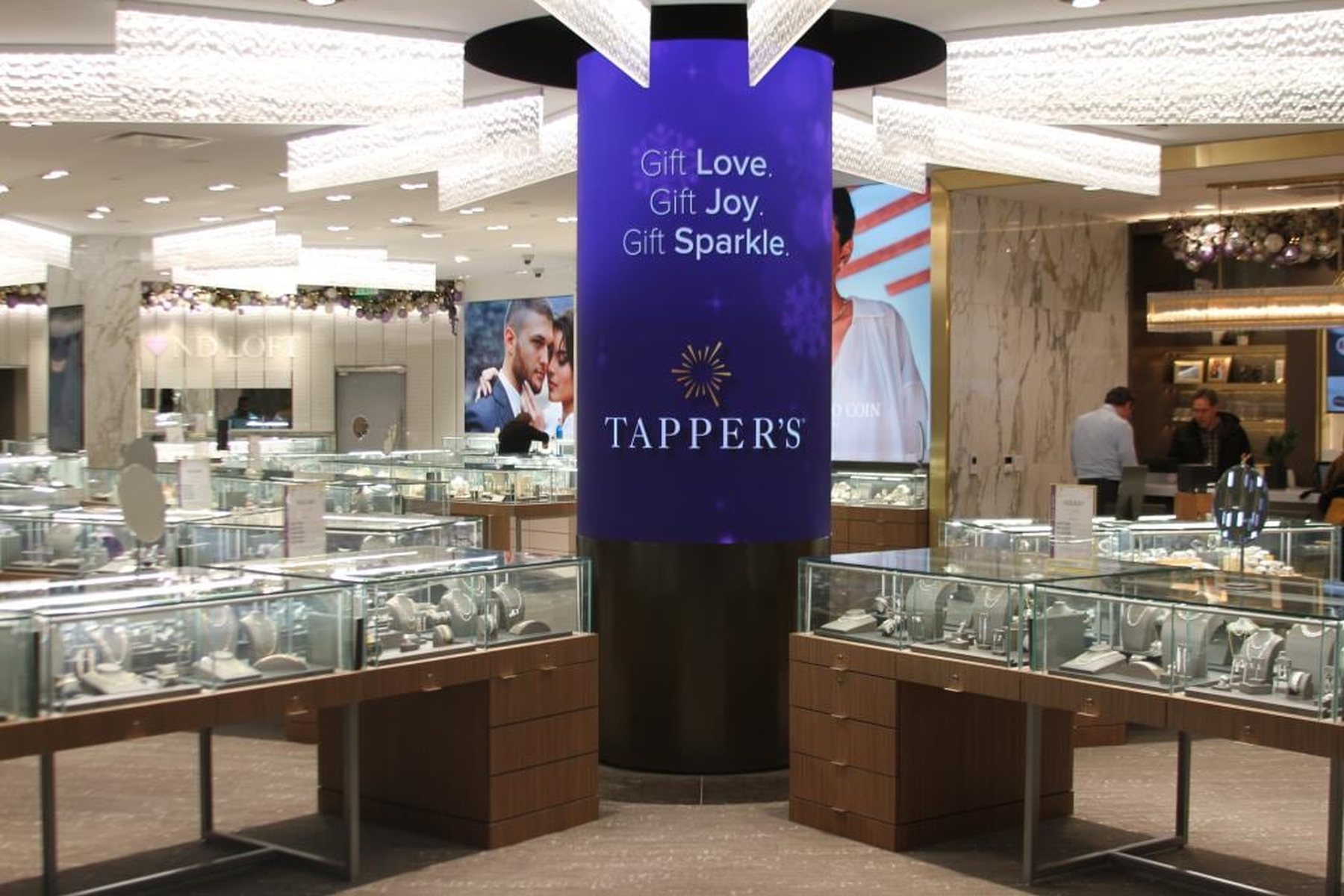
A high-street pharmacy with a 2 × 2.2 m entrance pane is viewed from 2 to 3 m on the pavement; a 6.25 mm film of around 20 modules covers the upper half of the glass. Content is the duty rota, opening hours, seasonal health reminders and over-the-counter campaigns; after closing only the duty-pharmacy information plays at reduced brightness. Because the shelves stay visible while the film plays, the pharmacy does not have to empty its window to gain a screen, and the green cross outside keeps its job.
Jeweller
A jeweller's window means small products and carefully set light, so the film covers a band across the top of the glass rather than the whole pane. A 1.2 m high strip at 5 mm pitch plays collection animations and the brand mark while the trays below stay completely open. The real gain for a jeweller is transparency: nothing is placed in front of the product and the interior lighting scheme is untouched. Built in gold and white tones on a dark ground, the picture frames the pieces instead of competing with them.
Clinic and practice
At the entrance of a dental, aesthetic or eye clinic the glass is large and the message is small and calm. An 8 mm film on a 3 × 2.5 m pane shows the service headings, the practitioners and the appointment call to action in slow transitions. Patients waiting inside see the film from behind only faintly, so the waiting area is not disturbed. Where a clinic needs the interior hidden for privacy, film is the wrong product; there a Poster LED Display with a closed back, or frosted glass with a wall screen inside, is the recommendation.
Café and restaurant
A café front is usually several panes with tables against the glass, and this is where the film's main advantage shows. The customer inside keeps the view out, while the passer-by reads the day's menu, the breakfast hours and the evening event on the glass itself. A 6.25 or 8 mm film goes on the two panes nearest the door; each scene carries one dish, one offer and one line of invitation. Three schedules run for morning, noon and evening, and brightness falls with the sunset so the terrace is not lit like a stage.
Currency exchange
A currency exchange needs a screen anyway; the problem is that the rate board covers the window. Transparent LED film moves the board onto the glass: at 5 mm pitch, green and white figures on black read clearly from the pavement while the counter behind stays visible. The rate feed connects to the control software and the table updates automatically, so nobody types figures by hand. Figures need a height of at least 12 pixels to be read; a 1 m high band carries a six-row table comfortably.
Estate agency
An estate agent's window is a listings board, and the traditional A4 sheets both block the glass and go stale. A 6.25 mm film on 3 to 4 m² of corner glass shows a rotating feed of listings: photograph, number of rooms, district and a QR code. Listings come from the agency's own software and a sold property drops off the screen the same day. Because the office stays visible, a customer sees who is inside before opening the door, and in property that sense of trust is worth a great deal.
Car showroom
A showroom front is large, the viewing distance is long and the car inside is the real product. A 10 mm film at 98% transparency does not hide the car; the brand campaign and model launch, legible from 20 m, run along the façade. Two 5 × 3 m panes carry about 200 modules driven from one controller. On a south-facing front the picture will fade around midday, so the content schedule leans on morning and evening; if the façade is due for renewal anyway, hologram glass joins the conversation.
Limits: when a poster or a wall screen is the better choice
Not every pane suits film, and an honest supplier says so. If the viewer stands within a metre and expects photographic quality, even 5 mm looks coarse; that window needs a Poster LED Display at 1.5 to 2.5 mm or an XR Fine wall behind the glass. Very large façades in direct sun wash out at midday on 1,500 nits. Where the interior is meant to be hidden, transparency is a problem, not an asset. Door glass takes knocks every time it swings, so fixed panes are preferred; the outer face cannot take the film. Our LED sign vs LED screen guide walks through this decision tree.
Maintenance, cleaning and lifespan
Because the film sits on the inside face, it is protected from rain, dust and vandalism, and the outside is cleaned as usual. The inside face is wiped gently with a soft microfibre cloth and an alcohol-free glass cleaner, without pressure, squeegees or abrasives. The LEDs are rated for 100,000 hours; at twelve hours a day that is more than twenty years before brightness drops to half. Power supplies and receiving cards live shorter lives, so a spare of each is kept on the shelf, and if one module fails only that module is replaced.
The operating range is minus 20 to plus 55 degrees; the heat behind a window stays within it, but keep the film away from a fan heater and avoid a closed air pocket between glass and film. An annual check covers the connectors, the power supply, the brightness schedule updated for the season and the content calendar. After installation Xeron provides remote monitoring and content updates, and most adjustments are made without a visit to the shop.
Municipality and mall rules
A glass façade LED installation is treated in many districts under the signage and advertising regulations. Because there is no permanent intervention on the façade and the film is applied from inside, the permit process is lighter than for an illuminated sign, but limits on brightness, moving content and night-time hours vary by district, and flashing content is prohibited near traffic lights. Inside a mall, the window design guide sets the screen size, a brightness ceiling and a ban on sound; the application file contains the screen dimensions, brightness, power draw and sample content. Xeron prepares that file; the final approval belongs to the management and the municipality.
What drives the cost of LED film for glass
Xeron prepares a separate quotation for every pane, so you will not find a list figure here, and we would advise caution with any supplier who offers one. The items that drive the cost are well defined, and understanding how a quotation is built makes comparison easier. The largest multiplier is surface area: the film is quoted per square metre and the number of modules follows directly from the area. The second is pixel pitch; over the same area a 5 mm film carries four times as many pixels as a 10 mm film. The remaining items are listed below.
- 01Surface area in square metres and module count; the number of panes and the separate cabling of each.
- 02Pixel pitch: pixel density changes fourfold between 5 mm and 10 mm.
- 03Control system: receiving cards, number of power supplies, live feeds such as rates or listings, remote management.
- 04Installation: number of panes, working height, curvature, length of the cable route and readiness of the electrical supply.
- 05Content: the launch package and monthly refresh; the maintenance and spare-parts agreement.
Turning your window into a screen does not take a large project; it takes a proper survey. Send the size, the orientation and a photograph of the glass through the Start a Project page, and we will show you in a written proposal which pitch, how many modules and what kind of content schedule fit that pane. A photograph of the window and the glass dimensions are usually enough for a first assessment, and the survey date is agreed in the same exchange.
Frequently asked questions
What is adhesive LED film for glass?
It is a 2 mm flexible, transparent LED layer bonded to the inside face of existing glass. Its LEDs are fed by fine conductor traces and the glass keeps 93% to 98% transparency. It needs no frame, no drilling and no glass replacement; the picture sits on the glass and, when the film is off, the pane looks as before. Xeron supplies it as Jellyfish LED Film in four pitches.
How does LED film differ from a transparent LED screen?
Transparent LED screen is the umbrella term; it covers mesh panels, hologram glass and LED film. Film bonds to the glass you have and gives the highest transparency. A mesh screen is a rigid panel that needs a carrying structure and reaches outdoor brightness. In hologram glass the LEDs sit inside a new glass unit. Tenants choose film, façade renovations choose hologram glass, and large exterior façades choose mesh.
Is LED film visible in daylight and direct sun?
Its 1,500 nits read comfortably by day on shaded, north-facing and mall-interior glass. On south- and west-facing glass in direct midday sun the picture fades for a few hours; an awning, an additional anti-reflective film and a content schedule weighted to morning and evening reduce the effect. For very sunny, very large façades that need higher brightness, a mesh screen or hologram glass is recommended instead.
How long does LED film installation take, and does the shop close?
A single window pane takes two to four hours and one day including cabling and commissioning; a front with several panes takes one working day. The team works inside the window, the pavement is not blocked and the shop stays open. The inside face is cleaned, the modules are aligned and applied without bubbles, and the cables run from the edge of the glass into the ceiling void.
Which pixel pitch should transparent LED film have?
The rule is simple: the pitch in millimetres is close to the comfortable viewing distance in metres. Pharmacy, jeweller and café windows watched from 2 to 5 m on the pavement take 5 or 6.25 mm; showroom and office façades watched from 10 to 20 m across the street take 8 or 10 mm. As the pitch grows, transparency rises and power consumption falls.
What decides the cost of LED film for glass?
Surface area and module count, pixel pitch, the control system and any live data feeds, the difficulty of the installation, and the content and maintenance package. Xeron treats every pane as its own project and quotes in writing, so there is no list figure. The size, orientation and a photograph of the glass are enough for a first assessment and a written proposal.