LED floor screens: a guide for dance floors, stages and interactive floors
How to choose an LED floor screen: load rating in kg/m², pixel pitch, anti-slip surface, interactive sensing and installation for dance floors, stages and XR.
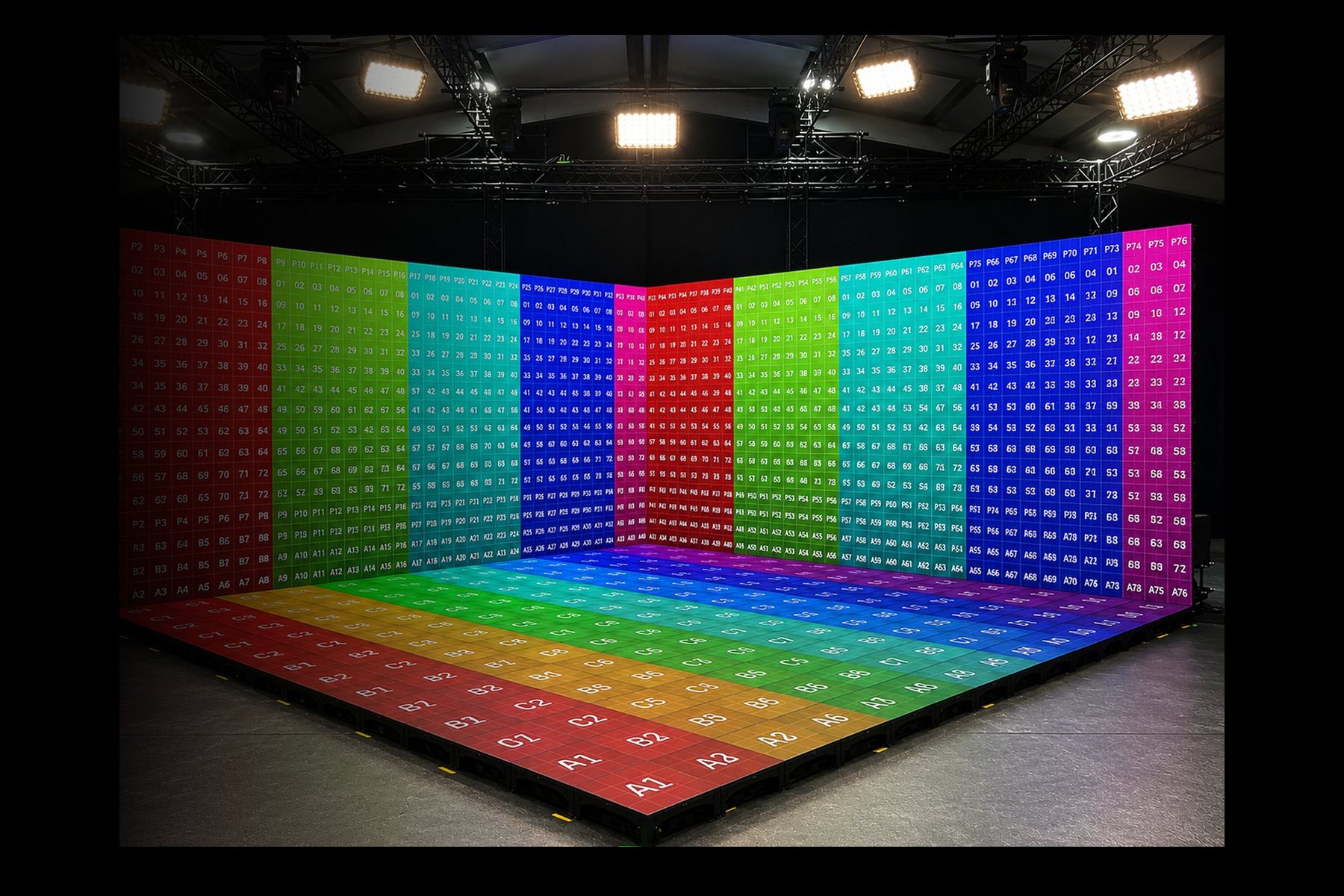
An LED floor screen is the only display in a show that people stand on, dance on, push flight cases across and occasionally spill a drink over, so it is chosen by different rules from the wall behind it. Load rating, surface and levelling come first; pixel pitch and brightness come second. This guide covers the structure of a floor cabinet, what kg/m² really means, the right pitch for a surface seen from above, interactive LED floors, and worked examples for weddings, stages, XR studios, showrooms and museums.
What makes an LED floor screen different from a wall cabinet
A wall cabinet only has to carry itself and the cabinets hung beneath it. A floor cabinet works in compression: the load arrives from above, passes through the mask and the module into a die-cast frame, and leaves through the feet into the subfloor. The frame is therefore a structural part with a published rating rather than a housing, and every other component is built around that load path. It is the product the market also calls a walkable LED display.
- 01Load-bearing frame: a ribbed metal structure that carries weight to the feet without bending the modules.
- 02Mask: a matte, anti-slip top layer of tempered glass or polycarbonate that protects the LEDs and spreads the pressure of a heel or a wheel.
- 03Sealed surface: gaskets around each module keep dust, confetti and spilled liquid away from the boards.
- 04Adjustable feet: independent levelling feet take up an uneven subfloor and leave cable space under the deck.
- 05Ramps and edge trims: sloped profiles close the open side, remove the trip edge and protect the outer cabinets.
In our range this product is XR Floor: a 500 × 500 mm cabinet of four 250 × 250 mm magnetic modules, weighing 10.5–11.5 kg thanks to a hollow frame, with independent feet that adjust over a 60–75 mm range. It is rated at 1,500 kg/m² with a threefold safety factor, has an anti-slip, anti-reflective surface and can be ordered with motion sensors. Configured for virtual production alongside the studio wall and ceiling, the same floor is called XR Deck. It shares the half-metre grid of rental walls, so floor and wall line up without filler pieces.
Load rating: what kg/m² means on an LED floor
The load rating is the first number to ask for and the one most often misread. A figure such as 1,500 kg/m² describes a uniformly distributed static load: weight spread evenly over the surface and standing still. Floors on the market are typically rated between 1,500 and 2,000 kg/m², with vehicle-rated builds above that. Three different loads act on a real floor, and only one of them is printed on the datasheet.
Distributed load: people standing and dancing
A tightly packed crowd reaches four to five people per square metre, or 320–400 kg/m² at 80 kg per person. Dancing adds a dynamic factor: a jump lands with two to three times body weight, so a full floor moving in rhythm can momentarily approach 1,000–1,200 kg/m². A 1,500 kg/m² rating with a threefold safety factor covers that with margin, which is why this class is the accepted standard for an LED dance floor or a stage.
Point load: heels, flight cases and tyres
Point load is weight concentrated on a small contact patch. A 500 × 500 mm cabinet rated at 1,500 kg/m² carries the equivalent of 375 kg spread across its surface; it does not accept 375 kg on a castor the size of a coin. A stiletto heel transmits little force but very high pressure, and the mask, not the frame, resists it. A loaded flight case puts 100–150 kg on each wheel; a 2,200 kg electric car puts about 550 kg on each tyre, on a patch of roughly 15 × 20 cm. That case needs the point-load figure, not the distributed one.
The subfloor carries everything
The floor passes every load, plus 42–46 kg/m² of its own weight, to whatever lies beneath it. Rental stage decks are commonly rated at 500–750 kg/m² and older ballroom floors sometimes less; a 1,500 kg/m² screen does not raise the capacity of the structure under it. On a stage build the deck rating is the limit. For permanent floors a structural engineer confirms the slab first.
Pixel pitch for an LED floor screen seen from above
A floor is looked at from unusual positions. A person standing on it has eyes 1.6–1.8 m above the surface and looks at content two to four metres ahead, a viewing distance of 3–4.5 m. Seated guests are 3–10 m away and see the surface at a shallow angle; a camera crane or a balcony looks down from 4–6 m. Under the ten-times rule from our pixel-pitch guide, where the pitch in millimetres equals the minimum comfortable distance in metres, P3.9 satisfies almost all of these positions and P2.6 all of them.
That is why floors are built between P2.6 and P4.8, with P3.9 as the workhorse. Seen obliquely, pixels compress along the line of sight, and the mask diffuses each LED slightly, so a floor looks denser than a wall of the same pitch. A finer pitch than the viewing positions require only puts smaller, more delicate LEDs under people's feet. The exceptions are broadcast and XR stages, where a low camera sits 1.5–2 m from the surface and P2.6 is normal. XR Floor comes at 2.6 mm for indoor use and 3.9 mm for indoor and outdoor use.
Interactive LED floors: sensing, latency and content engines
An interactive LED floor reacts to the people on it: ripples spread from a footstep, tiles light up under a child, a product appears where a visitor stops. Typical uses are brand activations, museum exhibits, retail entrances, children's areas and games at corporate events. The display is the same; what is added is a sensing layer and a real-time content engine.
Pressure or infrared sensing
Two methods are built into floor modules. Pressure sensing registers the weight on a module; it is robust, indifferent to lighting and reports only real contact. Infrared sensing places emitter-receiver pairs between the LEDs and detects the reflection from a shoe just above the surface; it gives a finer grid, but tungsten fixtures or direct sun can disturb it, so it is tested under show lighting. Large permanent rooms can instead track people from above with depth cameras.
Latency and the content engine
Sensor data travels to a media server, where a real-time engine renders the response and sends it through the LED processor to the cabinets. A sensor scan at 30–60 Hz costs 17–33 ms, a rendered frame about 17 ms, and the processor and receiving cards one to two frames more. A total under 100 ms feels immediate; above 150 ms the effect visibly trails the foot. One sensing point per 250 mm module is enough for footsteps and games.
Where LED floor screens are used: five worked examples
Wedding and gala LED dance floor, 6 × 6 m
A 6 × 6 m wedding LED dance floor is 36 m², or 144 cabinets, and suits a ballroom of 250–400 guests. At P3.9 the canvas is 1,536 × 1,536 pixels. The floor weighs about 1.6 tonnes, roughly 45 kg/m², which any ballroom slab carries; the dancers are the real load. Average power is around 10 kW and the theoretical maximum about 30 kW, well above what a floor at 30–40 per cent brightness draws. Choose the IP65 version, because drinks will be spilled. A crew of four lays and levels the area in three to four hours.
Concert and TV stage floor with a back wall
On a concert or television stage the floor extends the back wall towards the audience. A 12 × 8 m LED stage floor is 96 m² and 384 cabinets, about 4.4 tonnes, in front of a 12 × 6 m XR Event or XR Arena wall. With both at P3.9 the content team treats them as one canvas: 3,072 × 1,536 pixels on the wall and 3,072 × 2,048 on the floor. Risers and drum platforms get load-spreading pads, and the stage deck below is rated for the combined weight. Outdoors, the 3,000-nit IP65 version is used, on a deck with a slight fall for rain.
XR and virtual production floor matched to the wall
In a virtual production volume the floor is in shot, so it must match the wall in the camera, not just to the eye. XR Deck at P2.6 under an XR Studio wall of 1.9–2.6 mm keeps the pixel structure comparable; an 8 × 6 m floor is 192 cabinets and 3,072 × 2,304 pixels. Floor and wall are calibrated to the same colour space and white point, ideally from matched LED batches, and a 3,840 Hz refresh rate with genlocked processing keeps scan lines out of the picture.
Two camera problems are specific to floors. Moiré appears sooner, because a camera at a grazing angle sees the pixel rows compressed until they beat against the sensor grid; the remedies are a finer pitch, a slightly soft focus plane and no very low, long-lens shots. Reflection is the second: a glossy mask mirrors the wall and the lighting rig, while a matte anti-reflective mask holds the black level. Our virtual production article covers the seam between floor and wall.
Automotive showroom and turntable area
A showroom LED floor of 8 × 5 m is 40 m² and 160 cabinets; at P2.6 it shows 3,072 × 1,920 pixels. The car is the difficulty. At 550 kg per tyre, one wheel exceeds the 375 kg a cabinet carries as a distributed load, and steering on the spot grinds the mask. The clean solution puts the car on a turntable with its own structure and runs the LED floor around it. If the car must stand on the LEDs, the point-load capacity is verified for that vehicle, spreader plates go under the tyres and the car is rolled on without steering.
Museums and experience centres
A museum floor runs ten to twelve hours a day for years, usually in a darkened room and often with interactive content. A 5 × 4 m floor is 80 cabinets and, at P2.6, 1,920 × 1,536 pixels; the fine pitch is justified because children sit and crouch on the surface. Brightness is set at 300–600 nits, which extends LED life. Permanent floors are planned with top-side service access, three to five per cent spare modules from the same batch and a written cleaning routine.
Surface and safety: anti-slip class, glare, heels and liquids
The surface is a safety component before it is an optical one. Ask for the documented anti-slip class of the mask, tested under a recognised standard such as the R scale used for floor coverings; dry indoor event floors typically sit around R9–R10, and wet or outdoor surfaces need more. Glare is the second property: under moving lights a glossy mask throws reflections into cameras and front rows and lifts the black level, so a matte, anti-reflective finish is standard on stage and studio floors.
Polycarbonate masks are tough and light but mark over time, and on rental floors they are a wearing part. Stiletto heels are acceptable on a rated mask, and flight cases on wide rubber castors may cross within the point-load limit; pallet trucks, scissor lifts and pianos need track plates. For liquids, check the IP rating of the top surface: in the XR Floor range the 3.9 mm versions are sealed to IP65, while the 2.6 mm indoor version is an IP30 studio product that must stay dry. Clean with a damp microfibre mop and a neutral cleaner, never with solvents or a pressure washer.
Installing an LED floor screen: flatness, levelling, cables and ramps
Installation starts with the subfloor. Carpet is removed or covered with plywood, because feet sink into pile. The first row is set from a reference line with a laser level and each cabinet is brought to height with its independent feet; the 60–75 mm range of XR Floor absorbs the unevenness of most ballroom, stage and exhibition floors. The target is a lip of under half a millimetre between cabinets. Open edges get ramps or trims: wheelchairs and catering trolleys need a slope near 1:12, which for a deck about 10 cm high means a ramp around 1.2 m long in the room layout.
Power and data run under the deck through the hollow frame, never across a walkway. Supplies are planned for peak draw: XR Floor takes 60–80 W per cabinet on average and 180–240 W at maximum, so a 16 A circuit feeds about 14 cabinets and a 144-cabinet dance floor needs a three-phase distribution board. A gigabit data port carries about 39 cabinets at P3.9 and 17 at P2.6. Floor cabinets are fanless and shed heat into the air space below, so the perimeter is never sealed airtight. Service is from the top: a suction tool lifts a magnetic module out and a replacement goes in within a minute.
Content for a floor: perspective, slow motion and lower brightness
Floor content is designed for a surface seen in perspective. A guest seated eight metres away with eyes 1.2 m above the floor sees it at about eight degrees; a six-metre-deep floor fills no more of their view than a wall 90 cm high. Fine detail and text collapse at that angle, while large shapes, gradients and light sweeps survive. Movement under the feet is also felt: fast scrolling, strobing and rotation unsettle balance, especially in heels, so floor content moves slowly.
Brightness is lower than on a wall. Indoor floors have 600–1,500 nits available and usually run at 20–40 per cent of it, because a floor lights faces from below, flattens photographs and dazzles dancers looking down. A dark base with bright accents looks richer than a white field and keeps power and heat down. The exception is daylight: an outdoor stage floor needs the 3,000-nit version. Brightness is set on site, with the show lighting running.
On a floor, load rating and surface are chosen first and pixel pitch second; nobody cares about the picture on a deck that is not safe to stand on.
Rental or permanent LED floor
Most LED dance floors and stage floors are rented: the event lasts a night or a tour leg, the floor arrives in flight cases of six cabinets, and the supplier provides the crew, ramps, processor and a show technician. What drives the cost is the area, the pixel pitch, the number of show days, the interactive option, the build hours the venue allows and whether content is included. Our LED screen rental guide lists the questions to settle before signing. Xeron quotes every floor per project once those points are known.
Permanent floors in showrooms, museums, clubs and studios are usually recessed into a pit so that the surface finishes flush and needs no ramp. The pit is planned with the architect: depth for cabinet and feet, a level and sealed base, drainage, ventilation paths and conduits for power and data. Spare modules, the mask replacement interval and the service response time are fixed at the start, because a floor in daily use wears faster than any wall.
Common mistakes with LED floor screens
Most problems with floors are decided before the first cabinet is laid. These are the errors we see most often in briefs and on site visits; each is easy to avoid in planning and hard to correct on the day.
- 01Reading kg/m² as a point-load figure and parking a vehicle or a scissor lift on a floor rated for people.
- 02Forgetting the subfloor: a 1,500 kg/m² screen on a 500 kg/m² stage deck is a 500 kg/m² floor.
- 03Using a non-sealed indoor floor where drinks are served.
- 04Running the floor at wall brightness, which dazzles dancers and washes out every photograph.
- 05Laying the floor on carpet without plywood, or leaving no room for ramps in the table plan.
- 06Treating interactive content as a screen setting rather than software that needs time, testing and a fallback.
Send us the area, what will stand on the floor, the subfloor and whether cameras are involved; the Xeron team returns a proposal with a load check, pixel pitch, cabinet count, power and ramp plan. If you are also sizing the wall behind the floor, our guide to LED screen size for events gives the calculation. The short form on the Start a Project page is the quickest way to begin.
Frequently asked questions
How much weight can an LED floor screen carry?
Professional LED floor screens carry 1,500–2,000 kg/m² as a uniformly distributed static load; XR Floor is rated at 1,500 kg/m² with a threefold safety factor. That covers a dense, dancing crowd, which peaks near 1,000–1,200 kg/m². Vehicles, lifts and pianos are checked separately against the point-load capacity and the subfloor.
Which pixel pitch is best for an LED dance floor?
P3.9 is the standard for an LED dance floor. Dancers see the surface from 3–4 m and seated guests from 3–10 m at a shallow angle, where a finer pitch is not visible. A 6 × 6 m floor at P3.9 gives 1,536 × 1,536 pixels. P2.6 is for broadcast cameras working close to the surface.
Can a car be parked on an LED floor?
Only after a project-specific check. A 2,200 kg car puts about 550 kg on each tyre, more than the 375 kg a 500 × 500 mm cabinet carries as a distributed load. The usual solution is a turntable on its own structure with the LED floor around it; otherwise spreader plates and a verified point-load rating are needed.
How does an interactive LED floor work?
Pressure or infrared sensors in the modules report where feet are; a real-time content engine on a media server renders the reaction and the LED processor displays it. The chain should respond in under 100 ms to feel immediate. One sensing point per 250 mm module is enough for footsteps, games and brand activations.
Is an LED floor slippery or fragile under heels?
No, provided it is a real floor product. The mask has a documented anti-slip class and a matte texture, and it spreads the pressure of a stiletto heel so that the LEDs underneath are never touched. Wipe spilled drinks at once, and choose an IP65 top surface wherever liquids are served.
How long does it take to install an LED floor?
A crew of four lays and levels a 6 × 6 m floor of 144 cabinets in three to four hours on a flat, hard subfloor, plus time for ramps, cabling and a content test. Carpet and uneven floors add time. The floor goes in before the tables and comes out last.