LED video wall vs LCD video wall: which is right for boardrooms and control rooms
LED video wall or LCD video wall? Seams, brightness, lifespan, 24/7 duty, depth and 7–10 year total cost compared for boardrooms, lobbies and control rooms.
LED video wall or LCD video wall is the first decision in most corporate AV projects, and it is decided too often on purchase price alone. Both promise the same thing, a large, continuous, always-on image surface, and deliver it in different ways at different long-term costs. This guide puts the two side by side without favour: what a video wall is, how LCD and LED video walls work, where they part ways across ten criteria, which suits a boardroom, a lobby, a control room or a studio, and how their cost compares over seven to ten years.
What is a video wall?
A video wall is a group of display units arranged edge to edge, in rows and columns, and driven by a processor so that they behave as one large screen. The term covers everything from a 2×2 array behind a reception desk to a twenty-metre operations wall, and the technology inside the units separates the two families. In an LCD video wall the unit is an industrial 46–55 inch panel; in an LED video wall it is a cabinet, typically 600×337.5 mm, built from LED modules. That single difference drives every criterion below.
The signal path is similar in both. Sources such as PCs, video-conferencing codecs, SCADA clients and camera feeds enter a video wall processor, which splits the picture to the combined resolution of the wall and sends it to the units: one signal per panel on LCD, a single data chain from sending card to receiving cards on LED. In a control room the processor deserves as much attention as the display.
LCD video wall: how it works, what it does well and the bezel problem
An LCD video wall is built from 46, 49 or 55 inch industrial panels with narrow bezels and a 24/7 duty rating, mounted in arrays such as 2×2, 3×3 or 4×4. These panels are not consumer televisions: they carry a stronger backlight of typically 500–700 nits, a heat-resistant polariser, per-panel calibration and circuitry that reduces image retention. Behind each panel sits a pop-out bracket for front service, so a single panel can be replaced inside a closed recess without dismantling the wall.
- 01Lower entry point: a 2×2 wall of 55 inch panels enters well below a fine-pitch LED wall of the same size.
- 02High resolution: every panel is Full HD or 4K, so a 3×3 wall reaches 5,760×3,240 pixels, useful for text and small windows read up close.
- 03Easy supply and service: panels are standard products, most integrators know them and replacements are quick to source.
- 04Natural multi-source display: one source per panel is trivial through a matrix output.
The bezel problem
The unavoidable weakness of an LCD video wall is the seam where panels meet. The combined width of two adjoining bezels ranges from 0.44 mm on the thinnest current panels to 1.8 mm on the common class and 3.5 mm on older generations. From three metres, watching full-screen video, the line is easy to forgive. The moment a map, a spreadsheet or a face in a video call falls across it, the eye goes to the seam and stays there. Extreme-narrow-bezel panels shrink the gap but cannot remove it; a seamless LCD video wall is physically impossible.
What happens over the years
The second weakness appears with time. LCD backlights age at slightly different rates, so after five years of continuous use individual tiles in a 3×3 wall can be visibly dimmer or warmer than their neighbours, and a replacement panel stands out as brighter than the rest. In control rooms showing static layouts, image retention also varies from tile to tile. It can be managed with recalibration, but on a 24/7 wall it is the hidden line in the cost of ownership.
LED video wall: fine pitch, COB and a seamless surface
An LED video wall is built from cabinets, each carrying its own LED modules, power supply and receiving card. For indoor corporate work the pixel pitch is chosen between P0.9 and P1.9; at 1.2 mm and below the modules are increasingly COB or flip-chip COB, with the LED chips mounted directly on the board under one resin layer rather than in individual packages. The result is a continuous plane with no visible line between cabinets: a 2×2, a 4×3, a 9:1 ribbon or a wrapped corner all sit on the same uninterrupted surface.
The numbers are different too. Fine-pitch indoor LED delivers 600 to 1,500 nits and dims to suit the room; LED life is rated at 100,000 hours to half brightness, more than eleven years of 24/7 operation. Cabinet depth has dropped below 30 mm, and front-service cabinets let modules and power supplies be swapped magnetically from the front. In the Xeron range, XR Ultra covers 0.78–1.5 mm for boardrooms and control rooms, XR Fine 1.2–3.1 mm for lobbies and larger walls, and XR Seamless offers VESA-mounted cabinets for control-room walls. Package types are compared in our COB and SMD guide.
LED has its own trade-offs. Cost per square metre is higher than LCD, and it climbs sharply below 1.2 mm. Pixel resolution is lower than LCD: a 3 metre wide wall at 1.2 mm is about 2,500 pixels across, where a 55 inch LCD wall of the same width offers 3,840. That matters for 9-point text read at one metre and not at all for a presentation read from three. Installation needs a steel sub-frame and calibration, and a damaged module is replaced by a trained technician rather than swapped like a panel.
Once the eye has found the seam, it never sees only the picture again.
LED video wall vs LCD video wall: ten criteria compared
The ten criteria below summarise the questions to ask when requesting a quotation for a boardroom or control room. Typical values are given for each; in your own project the viewing distance, the ambient light and the operating hours decide how much weight each one carries.
- 01Seamlessness: LCD has a 0.44–1.8 mm seam at every joint; LED has none.
- 02Brightness: LCD 500–700 nits; LED 600–1,500 nits, decisive in daylit lobbies.
- 03Resolution: LCD gives 4K per panel; LED depends on pitch, and 1.2–1.5 mm is enough at 3–5 m.
- 04Colour uniformity over time: LCD drifts tile by tile; LED is calibrated per cabinet and ages as one surface.
- 0524/7 reliability: LCD backlights are rated 50,000–60,000 hours; LED 100,000 hours with redundant power.
- 06Depth and installation: LCD with pop-out brackets needs 80–120 mm; LED cabinets are under 30 mm and recess flush.
- 07Heat and noise: LCD carries fans and backlight heat in every panel; fine-pitch LED runs fanless.
- 08Power: a 55 inch LCD panel draws 150–250 W; fine-pitch LED 100–200 W per m² in practice, 500–700 W at peak.
- 09Total cost over 7–10 years: LCD is cheaper to buy and adds a panel refresh; LED costs more to buy and runs one lifetime.
- 010Content flexibility: LCD is limited to multiples of 16:9; LED tiles to any ratio and can curve.
Seamlessness and resolution belong together
These two criteria balance each other: LCD offers more pixels but divides them with seams, LED offers fewer pixels in one piece. Viewing distance settles it. In a boardroom viewed from 3–5 metres, a 1.2–1.5 mm pitch is below what the eye can resolve, so LED's lower pixel count is invisible while LCD's seams are not. At an operator console read from 1.5 metres the situation reverses, and the choice becomes LED at 0.9 mm and finer or a single large LCD panel.
Brightness and ambient light
A boardroom needs a calibrated 350–450 nits and both technologies deliver it. The gap opens in glass-fronted lobbies and daylit open offices: an LCD panel's 500–700 nit ceiling, glossy surface and reflections leave it washed out at midday, while a 1,000–1,500 nit LED wall dims to the room and drops to 300 nits in the evening. An ambient-light sensor is essential on either system, but the range it can work with is far wider on LED.
Colour, lifespan and service over the years
In a 24/7 environment the most expensive problem is the one that appears in year five, not on day one. LCD backlights reach half brightness at roughly 50,000–60,000 hours and every panel ages on its own schedule; LED's 100,000 hour rating applies to the whole wall at once and per-cabinet calibration data lives in the processor. A failed LCD tile is replaced as a whole panel; on LED the same fault is usually a single module or power supply, swapped from the front by a trained technician. On both, a spare-parts stock belongs in the contract.
Depth, heat and power
For projects that want a flush wall, LED's sub-30 mm cabinets are decisive; LCD bracket systems need 80–120 mm for the pop-out mechanism and airflow behind the panels. Heat and noise are the criteria most often ignored in small rooms: the fans and backlights of nine 55 inch panels are audible in a quiet boardroom, whereas fine-pitch LED runs without fans. On power, compared per square metre at office brightness, the two are closer than datasheets suggest; LED's peak rating looks high, but real consumption should be measured at the 30–40% brightness it will run at.
Scenarios: boardroom, lobby, control room and broadcast
Boardroom, 3–5 m viewing
A 20–40 m² boardroom has two realistic options: 55 inch LCD in a 2×2 array, about 2.4×1.4 m, or a 3–3.6 m wide LED wall at 1.2–1.5 mm pitch. If the room hosts presentations and video calls and the table sits within three metres, the LCD seam runs through the centre of the picture, exactly where a presenter's face tends to be. In Xeron projects these rooms increasingly go to XR Ultra at 1.2 mm or XR Fine at 1.5 mm, and 165 inch class all-in-one LED units install in a day. LCD remains defensible when the budget is tight and the content is a single full-screen source.
Lobby and reception
In a lobby the viewer moves: past the wall at two metres, across the atrium at ten, usually in daylight. Here LCD's seams, lower brightness and 16:9 multiples become three separate handicaps. LED at 1.5–1.9 mm lets a 9:1 ribbon, a portrait panel or a wrapped corner become part of the architecture, and once the content is full-screen motion graphics the pixel count stops mattering. Our corporate LED wall guide covers proportion, depth and content for lobbies in detail.
Control room, 24/7
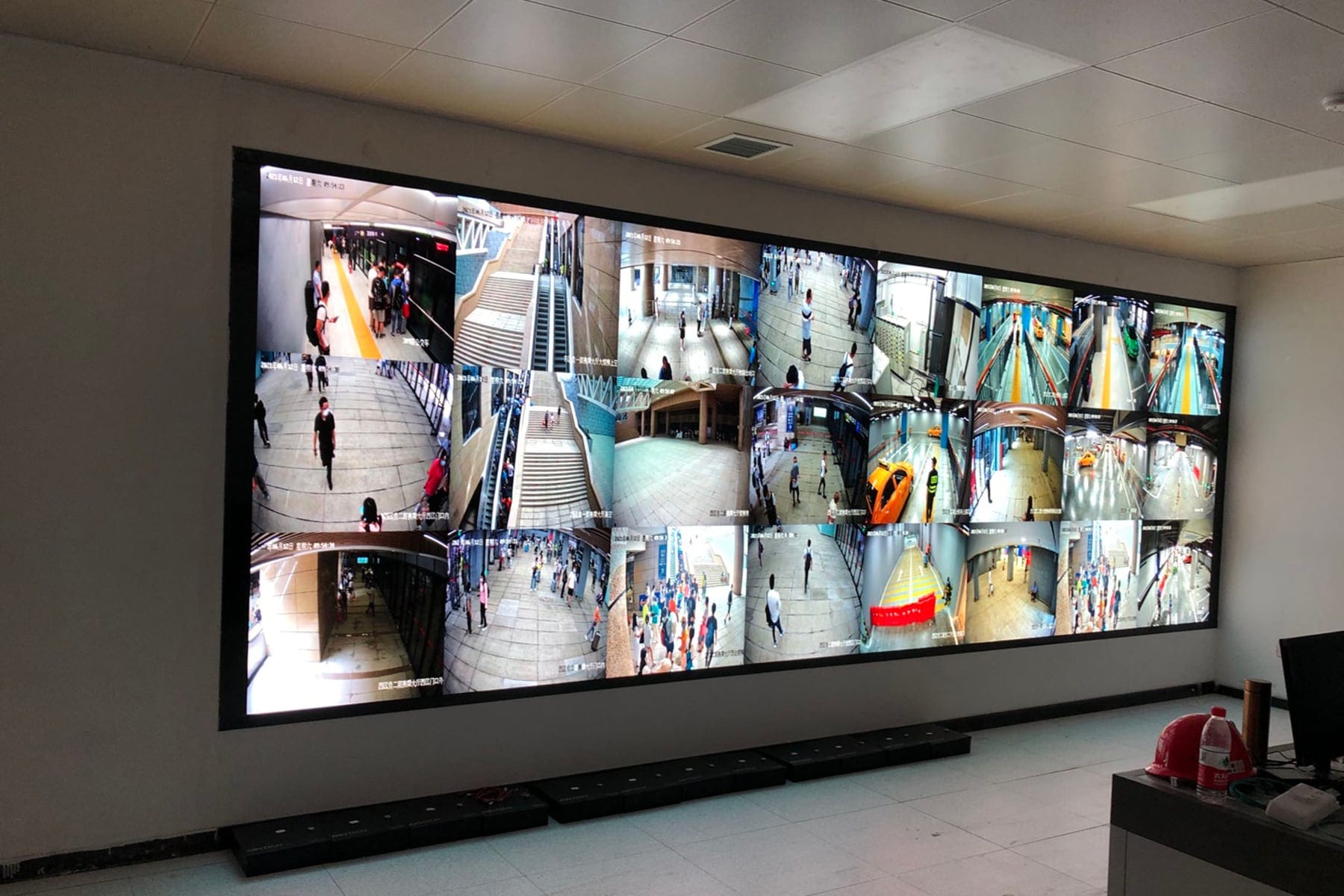
The control room is where the decision is argued most. For years it was LCD territory: many discrete sources such as SCADA screens, cameras and maps mapped neatly to one window per panel, and the price was right. Today LED is chosen for uniformity and service life: an operator who watches the wall for ten hours a shift wants one surface after five years, not nine tiles in different shades, and the 100,000 hour rating with redundant power lowers the total cost of a 24/7 wall.
The honest caveat: when the budget is tight and the content really is many small windows, a 3×3 or 4×4 LCD wall behind a good processor still works, with the seams falling between windows rather than through them. XR Seamless and XR Ultra are the front-service LED options in this category between 0.9 and 1.5 mm.
Broadcast and studio
On any wall that faces a camera, LCD's seams and LED's refresh rate decide the matter. For a studio backdrop, a newsroom wall or a corporate broadcast room, LED above 3,840 Hz with 16-bit grey scale is the only realistic option: LCD seams are visible on camera and panel brightness falls short under studio lighting. The XR Studio series is built for this use.
Video wall prices: what sets them and how they run over 7–10 years
Video wall prices are asked about first and settled last, because the figure is assembled from decisions rather than read off a list. Seven variables set it: the pixel pitch, since finer modules cost more per square metre; the finished size of the surface; the brightness class the room demands; the duty cycle, because a wall that never switches off needs redundant power and a service contract; the supporting structure, whether a bracket array, a steel sub-frame or a recessed niche; the processing and control layer; and the spare-parts stock held on site. Xeron prices every project against those seven, never from a catalogue rate.
At first sight LCD is the lighter commitment, and on small walls it stays that way: a 2×2 LCD array enters well below a fine-pitch LED wall of the same size. The gap closes across a 7–10 year window. On a 24/7 LCD wall the backlights reach half brightness at 50,000–60,000 hours, six to seven years of continuous duty, and panels are then refreshed as a set rather than one at a time, because a single new tile stands out brighter than its neighbours. That second purchase, the recalibration visits between and 150–250 W per panel are what the first comparison leaves out.
LED spends its ownership elsewhere. The surface is rated at 100,000 hours to half brightness, so the same decade is one lifetime instead of two; a fault is closed by swapping a module or a power supply from the front rather than a whole panel; and per-cabinet calibration keeps the wall one colour as it ages. As a rule of thumb, on 3×3 and larger walls running 24/7, LED overtakes LCD on total cost between year five and year seven. On a 2×2 boardroom wall running eight hours a day, LCD can stay ahead for the full ten years, and the decision rests on seams and image quality instead.
When an LCD video wall is still the right choice
Recommending LED unconditionally would not be honest. An LCD video wall remains the right answer when the wall is under three metres wide and shows a single-source presentation, when the budget sits below the entry level of LED, when the installation is temporary or will move within two years, when the content is dense text read up close, or when an existing LCD wall is being extended. In those cases choose an extreme-narrow-bezel, 700 nit, 24/7 rated panel series and a good processor, accept the seams and spend the money on content and control.
Conversely, if the wall is wider than three metres, the viewer moves, the room is daylit, a camera is involved, the wall will run 24/7 or the architecture wants a flush surface, an LED video wall is not only the better-looking option but the more economical one over ten years.
A short decision guide
- 01Single source, under 3 m wide, eight hours a day, tight budget: 2×2 LCD.
- 02Boardroom at 3–5 m, video calls and presentations: 1.2–1.5 mm LED (XR Ultra or XR Fine).
- 03Lobby with daylight, moving viewers and an architectural ratio: 1.5–1.9 mm LED (XR Fine).
- 04Control room running 24/7, uniformity and service life first: 0.9–1.5 mm front-service LED (XR Seamless or XR Ultra).
- 05Control room with many small windows and a limited budget: 3×3 or 4×4 LCD behind a strong processor.
- 06Studio or broadcast room facing a camera: LED above 3,840 Hz (XR Studio).
Xeron has installed both technologies in boardrooms, lobbies and control rooms across Istanbul and can prepare an independent comparison from your room dimensions and content plan. For pitch selection see our pixel-pitch guide, for room architecture our corporate LED wall guide, and to request a site survey and quotation describe your project on the Start a Project page.
Frequently asked questions
How much does a video wall cost?
A video wall is quoted, never listed. The cost is set by pixel pitch, the finished size of the surface, the brightness the room demands, the duty cycle, the supporting structure, the processing and control layer, and the service and spare-parts cover. Xeron prices each project after a site survey, so send your room dimensions, viewing distance and daily operating hours.
How long does an LED video wall last?
Fine-pitch indoor LED is rated at 100,000 hours to half brightness: about eleven years of 24/7 operation, or more than 25 years at ten hours a day. Power supplies and receiving cards may be replaced after 8–10 years, but the LED surface serves one lifetime. Running at 30–40% office brightness and keeping cabinets cool extends it further.
What pixel pitch should a boardroom video wall have?
For boardrooms viewed from 3–5 metres, a pixel pitch of 1.2–1.5 mm is sufficient; go to 0.9 mm if the table sits within two metres or dense spreadsheets are shown. In rooms used for video calls, a refresh rate above 3,840 Hz and calibrated brightness of 350–450 nits matter as much as the pitch itself.
Can an LCD video wall be seamless?
No. Even the thinnest industrial panels leave a combined seam of 0.44–0.9 mm where two panels meet, and 1.8 mm on the common class. The line hides in full-screen video but shows whenever a map, a spreadsheet or a face crosses it. A truly seamless surface is only possible with an LED video wall, where cabinets join with no visible boundary.
LED or LCD for a control room?
For walls that run 24/7, are watched for hours at a time and must stay uniform for years, LED is preferred: 100,000 hour life, per-cabinet calibration and front service. For rooms that show many discrete sources in separate windows on a limited budget, a 3×3 or 4×4 LCD wall behind a strong processor remains a valid solution.
What is a video wall?
A video wall is a set of display units, LCD panels or LED cabinets, arranged edge to edge and driven by a processor so that they act as one large screen. It is used in boardrooms, lobbies, control rooms and broadcast studios, and the type of unit decides its seams, brightness, lifespan and cost.