Corporate LED walls: designing lobby, boardroom and briefing-room displays as architecture
A lobby LED wall is the first thing a visitor reads about a company. How to specify pitch, depth, brightness and content for corporate LED displays that look built in, not bolted on.
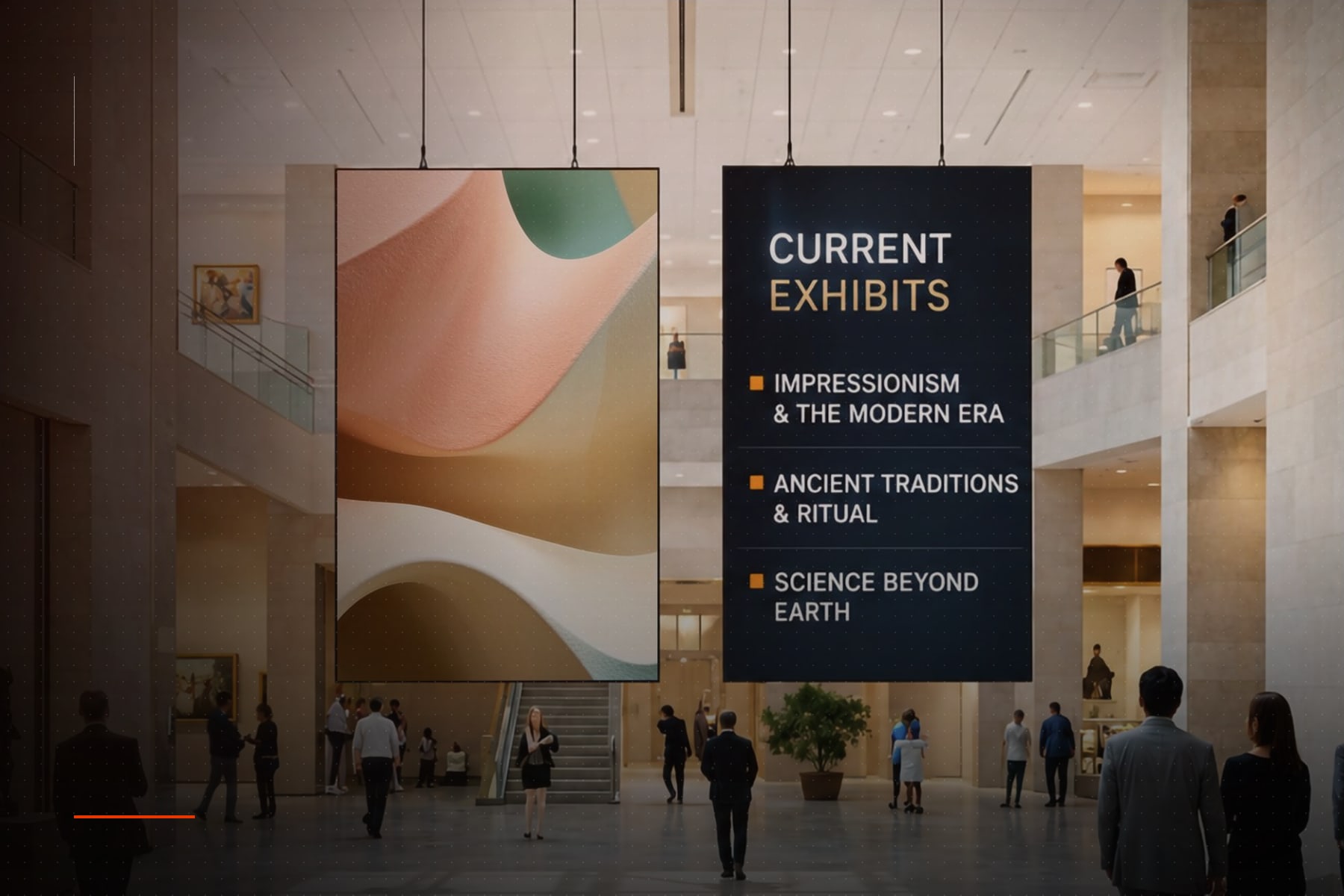
Corporate environments are built from proportion, material and light. An LED display that ignores those rules — a black rectangle bolted to marble — reads as an afterthought no matter how fine its pitch. A display that follows them reads as intent. This article covers how to design corporate LED walls for lobbies, boardrooms, briefing centres and open offices: the format decisions, the technical specifications that matter, and the content strategy that turns a screen into a statement of company identity.
The screen is a surface, not a device
The strongest corporate installations treat the LED surface as a material choice alongside stone, glass and timber. That means edge-to-edge coverage with no visible bezel, flush mounting inside the wall plane, and content authored for the exact aspect ratio of the architecture rather than a 16:9 file stretched across an ultra-wide surface. Once the display is planned as a surface, the choice of pitch, cabinet depth and brightness becomes a question of where people stand and how the room is lit.
Three decisions that define a corporate LED wall
Proportion
Size the display to the architecture, not to a television standard. Ultra-wide, portrait and wrapped formats are natural in LED because cabinets tile in any direction. A 9:1 ribbon above a reception desk or a 2:3 portrait panel beside a lift core often communicates more than a large 16:9 rectangle.
Depth
Sub-30 mm cabinets allow true flush mounting; the screen disappears into the wall plane and the surrounding finish runs up to its edge. Deeper cabinets need a recess or a build-out, which is where installations start to look added-on.
Content
Commission motion design for the space. Corporate identity in light behaves differently from identity in print: slow, high-contrast, generative or abstract pieces read better across a lobby than a corporate video with captions. Plan a content calendar the way a gallery plans exhibitions.
A well-designed lobby screen never looks switched on. It looks built in.
Lobby LED walls: brightness, pitch and viewing distance
Lobbies are typically daylit through glass façades, which means a lobby LED wall needs more brightness headroom than a boardroom — 1,000 to 1,500 nits calibrated down to ambient — with automatic dimming by time of day. Viewing distance ranges from two metres at reception to twenty at the entrance, so 1.5 to 1.9 mm is the usual pitch: fine enough for visitors who walk up to it, efficient enough for a wall of 20 m² or more.
Boardroom and briefing-room LED displays
Here the display is functional: spreadsheets, video calls, live dashboards and presentations. Fine pitch of 0.9 to 1.5 mm, calibrated uniform brightness and a refresh rate above 3,840 Hz for camera-facing rooms are non-negotiable. Front serviceability keeps maintenance out of working hours and off the ceiling. Look for cabinets that pass EMC Class B for offices and for processors that accept multiple inputs with picture-in-picture without a separate matrix switcher.
All-in-one LED for meeting rooms
For rooms between 20 and 60 m², all-in-one LED displays of 108 to 136 inches replace projector and screen with a single wall-mounted unit at 1.25 to 1.56 mm pitch, integrated processing and a wireless-presentation module. They install in a day and remove the alignment and calibration work of a bespoke wall.
What to specify in a corporate LED tender
- 01Pixel pitch matched to the closest viewing position (see our pixel-pitch guide).
- 02Cabinet depth under 30 mm for flush mounting, with front or rear service access stated.
- 03Brightness of 600–1,500 nits with automatic ambient dimming and a per-cabinet calibration report.
- 04Refresh rate above 3,840 Hz and grey-scale depth of 14 bits or more for camera use.
- 05Processor inputs, redundancy (dual power, loop-through data) and remote monitoring.
- 06Content production: who authors it, in what format and how often it changes.
Operating costs and lifespan
A calibrated fine-pitch wall running at 30–40% brightness in an office draws far less than its peak rating and reaches 100,000 hours of LED life. Energy-efficient LED platforms — common-cathode driving and low-power packages — reduce running cost and heat, which in turn removes the need for extra cooling in a sealed lobby.
Frequently asked questions
What pixel pitch should a corporate lobby LED wall have?
Most lobby walls use 1.5–1.9 mm. Go finer (1.2 mm) only if visitors regularly stand within two metres or the wall shows text; go coarser (2.5 mm) for very large walls viewed from across an atrium.
How thin can an LED wall be for flush mounting?
Modern fine-pitch cabinets are 25–40 mm deep. Under 30 mm the wall can be recessed flush with a plasterboard or stone finish.
LED wall or LCD video wall for a boardroom?
LED has no bezels, higher brightness and longer life; LCD is cheaper below three metres wide. For rooms that host video calls, LED with a refresh rate above 3,840 Hz avoids flicker on camera.
How much does a corporate LED wall cost to run?
A 10 m² fine-pitch wall at typical office brightness draws roughly 1–1.5 kW, far below its peak rating. Automatic dimming and efficient LED platforms cut that further.